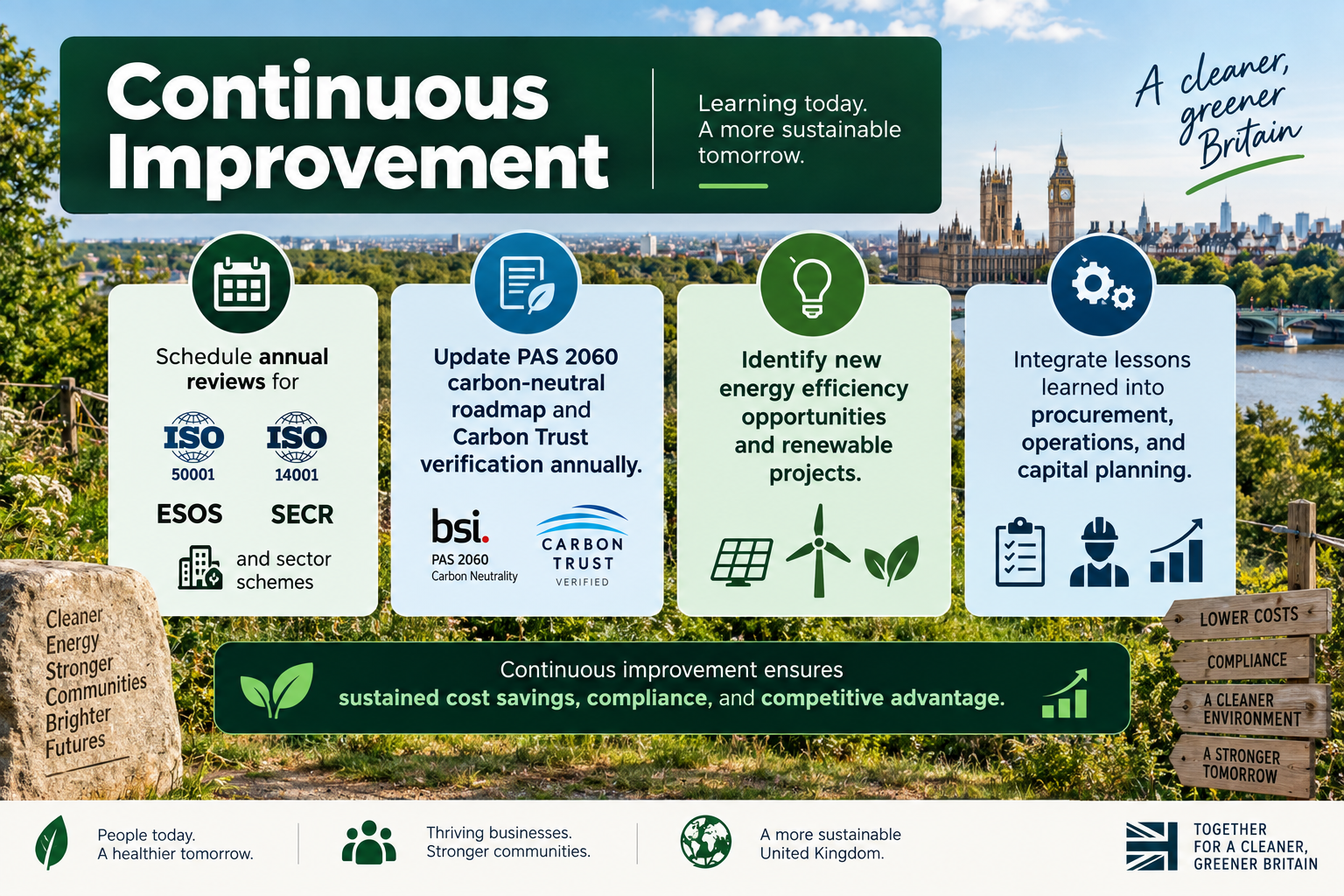

Beyond ISO standards, PAS, ESOS, SECR, and Carbon Trust certifications, manufacturers and engineers have access to a range of sector specific or voluntary schemes.
Key schemes include EMAS, B Corp, Responsible Sourcing Standards, SBTi validation, and product labelling schemes.
These can:
1. Complement energy, carbon, and environmental management efforts
2. Provide additional credibility for tenders, investors, and customers
3. Enable differentiation in competitive markets
4. Support ESG and corporate responsibility objectives
But why should manufacturers and engineers integrate these accreditations/schemes with core accreditations?
1. EMAS:
Extends ISO 14001 environmental management with verified reporting
2. B Corp:
Leverages ISO 14001, ISO 50001, and Carbon Trust performance metrics
3. Responsible Sourcing:
Supports Scope 3 emissions reporting and ESG claims
4. SBTi:
Provides science-based reduction targets aligned with ISO 14064 and PAS 2060
5. Product Labelling:
Uses ISO 14067 / PAS 2050 verified carbon data and renewable energy measures
Integration ensures streamlined management systems, reduces duplication of effort, and maximises both compliance and commercial benefit.
But what are the common challenges and solutions face by manufacturers and engineers when integrating these schemes?
1. Complexity of multiple schemes:
Adopt an integrated management system linking ISO, PAS, ESOS, Carbon Trust, and sector schemes
2. Supply chain data gaps:
Implement responsible sourcing and supplier reporting standards
3. Verification requirements:
Use ISO 14064 GHG data and ISO 50002 energy audits to support claims
4. Demonstrating tangible business benefits:
Link schemes to ROI, energy savings, renewable energy, and carbon reduction initiatives
Addressing these challenges ensures schemes deliver operational, commercial, and reputational value rather than just compliance paperwork.
Additional Resource
If you’d like to learn more about operational improvement / cost reduction related accreditations, please request a complimentary copy of our factories guide book – Planet meets Profit.