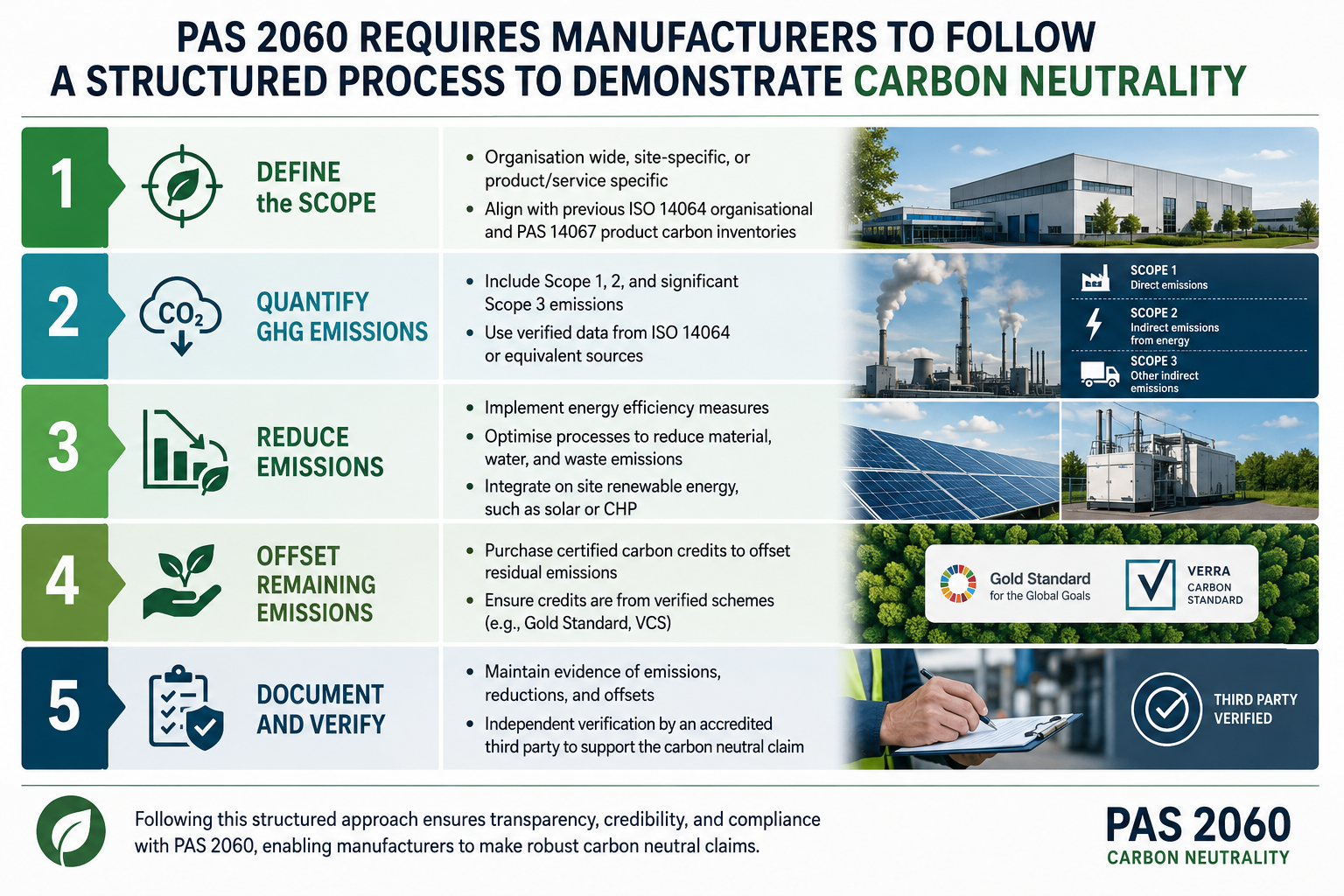
PAS 2060 requires manufacturers and engineers to follow a structured process to demonstrate carbon neutrality:
1. Define the scope
a. Organisation wide, site-specific, or product/service specific
b. Align with previous ISO 14064 organisational and PAS 14067 product carbon inventories
2. Quantify GHG emissions
a. Include Scope 1, 2, and significant Scope 3 emissions
b. Use verified data from ISO 14064 or equivalent sources
3. Reduce emissions
a. Implement energy efficiency measures
b. Optimise processes to reduce material, water, and waste emissions
c. Integrate on site renewable energy, such as solar or CHP
4. Offset remaining emissions
a. Purchase certified carbon credits to offset residual emissions
b. Ensure credits are from verified schemes (e.g., Gold Standard, VCS)
5. Document and verify
a. Maintain evidence of emissions, reductions, and offsets
b. Independent verification by an accredited third party to support the carbon neutral claim
Scope Considerations for PAS 2060
Manufacturers must clearly define the scope of their carbon neutral claim.
Common approaches include…
One:
Scope type – Organisation level
Description – Entire factory or company emissions
Example in Manufacturing – All energy, fuel, and waste at multiple sites
Two:
Scope type – Product level
Description – Specific product or range
Example in Manufacturing – Steel beams or packaged food product
Three:
Scope type – Product level
Description – Services provided
Example in Manufacturing – Logistics, maintenance, or assembly services
Defining the scope ensures carbon neutral clarity, avoids double counting, and aligns with ISO 14064 and 14067 emissions inventories.
Additional Resource
If you’d like to learn more about ISO and other operational improvement / cost reduction related accreditations, please request a complimentary copy of our factories guide book – Planet meets Profit.