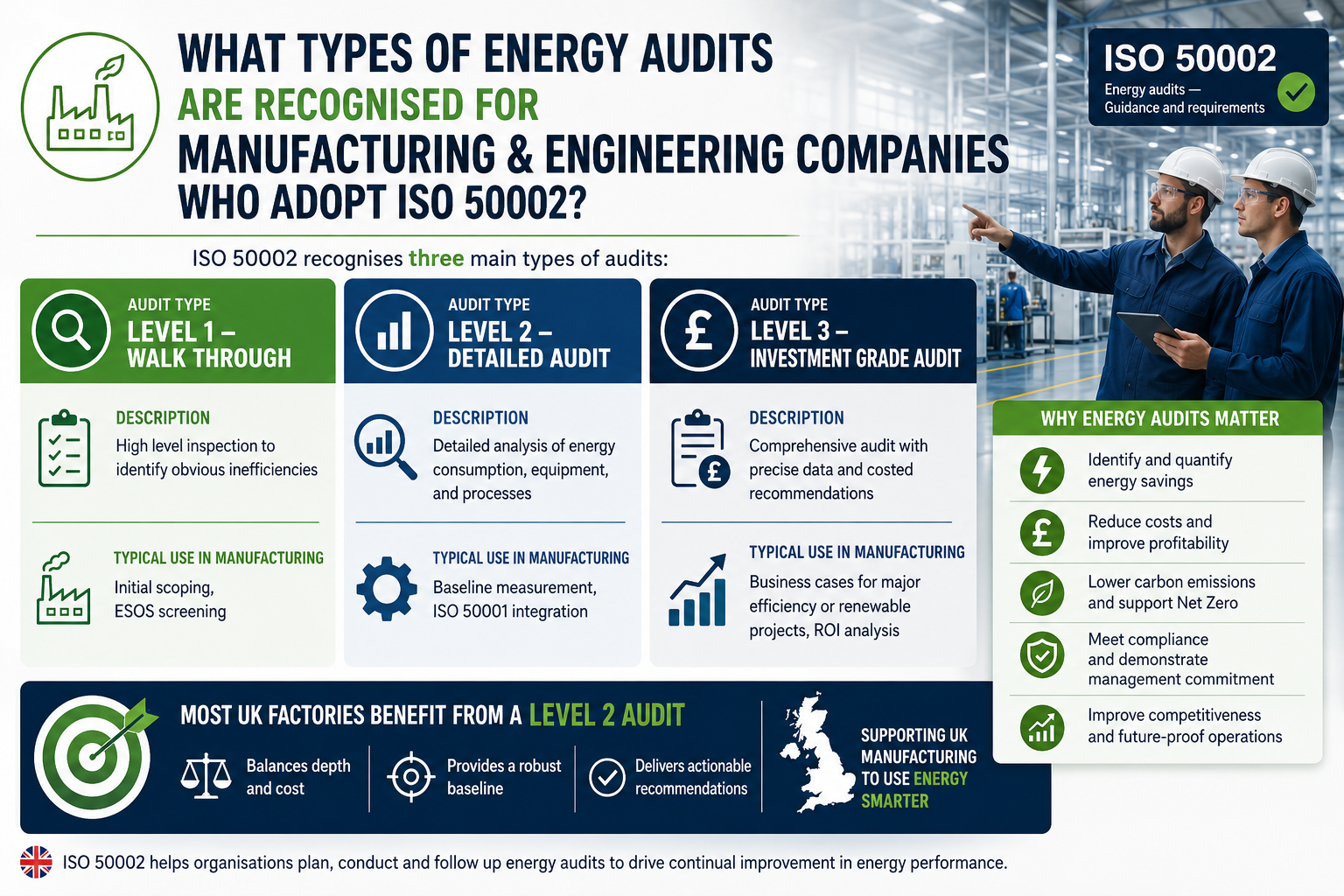
What types of energy audits are recognised for manufacturing and engineering companies who adopt ISO 50002?
ISO 50002 recognises three main types of audits:
Audit Type: Level 1 – Walk through
Description:
High level inspection to identify obvious inefficiencies
Typical Use in Manufacturing:
Initial scoping, ESOS screening
Audit Type: Level 2 – Detailed audit
Description:
Detailed analysis of energy consumption, equipment, and processes
Typical Use in Manufacturing:
Baseline measurement, ISO 50001 integration
Audit Type: Level 3: Investment grade audit
Description:
Comprehensive audit with precise data and costed recommendations
Typical Use in Manufacturing:
Business cases for major efficiency or renewable projects, ROI analysis
Most UK factories benefit from a Level 2 audit as it balances depth, cost, and actionability.
The Energy Audit Process
ISO 50002 defines a structured audit process:
1. Preparation
1a. Define scope and boundaries
1b. Gather historical energy data (electricity, gas, fuel, compressed air)
1c. Identify key processes and energy intensive equipment
2. Data Collection
2a. Measure energy consumption via meters or sub metering
2b. Record operational conditions, process schedules, and occupancy
2c. Capture environmental data (temperature, pressure, humidity) relevant to energy use
3. Analysis
3a. Identify significant energy uses (SEUs)
3b. Compare performance against benchmarks or industry best practice
3c. Calculate potential savings and associated costs
4. Reporting
4a.Summarise findings in an auditable report
4b. Prioritise opportunities by return on investment, feasibility, and impact
4c. Include energy and carbon reductions for verification under ISO 50001 / ISO 14064
5. Follow-up
5a. Track implementation of recommendations
5b. Monitor savings and update energy management system
Common Energy Savings
Energy audits typically identify opportunities for manufacturing and engineering companies – in the following areas:
1: Compressed air systems
Potential savings: 10 – 30%
Practical example: Leak detection, pressure optimisation, scheduling
2: HVAC and lighting
Potential savings: 5 – 15%
Practical example: LED retrofit, variable speed drives, motion sensors
3: Process heating
Potential savings: 5 – 20%
Practical example: Insulation, heat recovery, efficiency tuning
4: Motors and drives
Potential savings: 5 – 15%
Practical example: High efficiency motors, variable frequency drives
5: Energy procurement
Potential savings: 2 – 10%
Practical example: Tariff optimisation, demand side management
When combined, these savings often pay for the audit itself within 6 – 12 months, and continue to deliver cash positive results over the life of implemented measures.
Additional Resource
If you’d like to learn more about ISO and other operational improvement / cost reduction related accreditations, please request a complimentary copy of our factories guide book – Planet meets Profit.