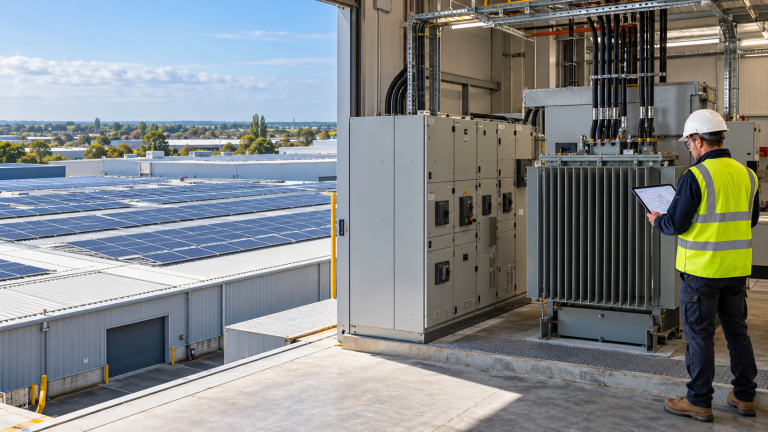

Before a UK manufacturer approves rooftop solar, its electrical engineer should consider more than panel output and transformer capacity. Factories with variable-speed drives, compressors, large motors, welders and sensitive automation may also need a power-quality assessment.
Solar does not automatically cause poor power quality. Modern grid-connected inverters are designed to meet technical requirements. Due diligence means understanding the site’s existing electrical conditions and how the proposed installation interacts with existing plant.
What is power quality?
Power quality describes whether voltage, current and frequency conditions remain suitable for connected equipment and the wider electricity network. Relevant considerations include harmonic distortion, voltage fluctuations, reactive power, power factor and voltage imbalance. Checks depend on the factory’s loads, electrical design and distribution network operator (DNO).
For a separate explanation of electrical infrastructure, read our factory solar transformer and LV/HV guide.
1. Harmonics and industrial equipment
Harmonics are electrical waveform components at multiples of the fundamental supply frequency. Non-linear equipment such as variable-speed drives, rectifiers, welding systems and other power-electronic devices can contribute harmonic currents. Under some conditions these currents cause unwanted voltage distortion.
Adding solar inverters changes the electrical configuration. A competent engineer should assess the combined installation rather than assume the new equipment is either harmless or problematic. This is particularly important where the factory has extensive drives, existing capacitor banks, previous power-quality complaints or a constrained connection.
UK Engineering Recommendation G5 addresses harmonic voltage distortion and connections involving non-linear equipment. Ofgem explains the G5 revision. Ask whether measurements, modelling or a formal harmonic study are required for the specific project.
2. Power factor and reactive-power charges
Power factor describes the relationship between real power and apparent electrical power. Factories with large motors often have power-factor correction equipment already installed.
When solar reduces daytime real-power imports, the power factor measured at the grid connection can change. The outcome depends on the site’s reactive-power demand, existing correction equipment and inverter controls. Solar does not automatically remove reactive-power charges or improve every tariff component.
Before signing off the investment, ask the electrical designer to review the tariff, capacitor banks, correction controls and potential interactions with harmonics. Inverter reactive-power settings must remain compatible with the approved design and DNO connection conditions.
3. Voltage fluctuations and sensitive production equipment
Some manufacturing lines are especially sensitive to electrical disturbances. Examples include precision machining, automated packaging, temperature-controlled processing and industrial control systems. An interruption may cost far more in downtime and scrap than the value of the electricity involved.
Solar output varies with sunlight, while industrial demand changes as machines start and stop. The designer should consider whether the combined installation needs a voltage-fluctuation assessment. UK Engineering Recommendation P28 addresses voltage fluctuations and flicker. The National Energy System Operator documents the implemented P28-related code change.
Standard grid-connected solar should not be presented as a solution to existing voltage dips or power cuts. Processes requiring continuity may need a separately engineered UPS, power conditioner or backup arrangement.
4. How G99 fits into power quality
Many UK commercial solar installations must follow the applicable generator connection process under Engineering Recommendation G99. National Grid Electricity Distribution’s G99 guidance explains that inverter-connected generation is assessed using the inverter’s continuous AC rating. Panel DC capacity, inverter AC rating and transformer kVA rating are not interchangeable.
Depending on the connection, the DNO may require inverter specifications, protection information, transformer data and supporting studies. Our factory solar DNO and G99 guide covers the wider application process.
5. Seven questions before approving the project
- Are the electrical drawings current? Confirm transformers, switchgear, major loads, metering and correction equipment.
- Has the site experienced disturbances? Review nuisance trips, equipment faults and maintenance records.
- Which processes are sensitive? Identify lines where a disturbance could create scrap, rework or costly downtime.
- Is baseline monitoring needed? Ask whether measurements should capture representative operating conditions.
- Have inverter interactions been reviewed? Consider harmonics, capacitor banks, switching and reactive-power controls.
- What does the DNO require? Record any G5, P28 or other study obligations and connection conditions.
- What will commissioning prove? Agree acceptance criteria, test evidence, responsibilities and escalation procedures.
6. Include electrical readiness in the financial appraisal
A credible proposal should identify which electrical surveys and studies are included and which remain provisional. Where filtering, protection changes, switchgear work or shutdowns might be required, understand the potential cost and programme impact before making the investment decision.
Start with half-hourly electricity data to understand when solar generation is likely to be consumed. Then integrate electrical readiness into the design rather than leaving it until installation.
Our production-downtime planning guide covers operational access. For the wider business case, visit Solar Panels for Factories UK.
7. Illustrative manufacturing scenario
Imagine a factory with several variable-speed drive production lines, a site transformer and an existing capacitor-based power-factor correction system. The roof looks suitable for a large solar array, but the electrical drawings are outdated and there are no recent power-quality measurements.
Rather than assume a problem exists, the project team commissions an appropriate review, confirms the DNO’s requirements and checks compatibility between the correction equipment and proposed inverters. Any necessary changes can then be priced before approval. This is an illustrative scenario, not a documented customer case or a promise of savings.
Conclusion
Factory solar power quality is a practical due-diligence issue. Reviewing harmonics, power factor, voltage behaviour and sensitive production equipment before procurement helps manufacturers understand the true project cost and avoid preventable surprises.
Considering a project? Contact Commercial Solar Systems to discuss a site-specific assessment.