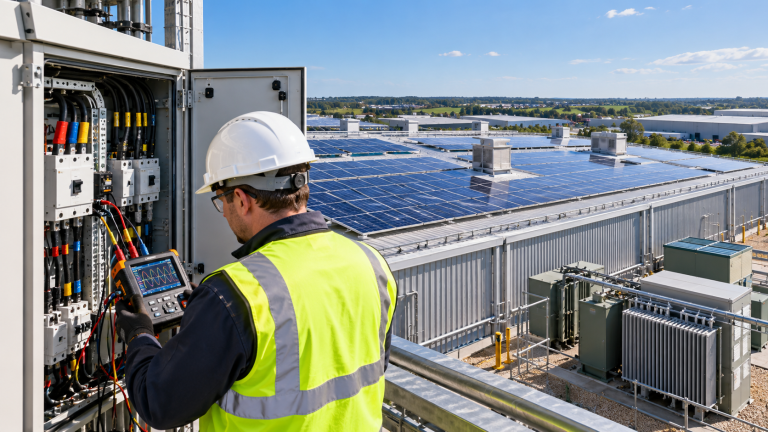

Can your factory’s existing electrical infrastructure accommodate a new rooftop solar PV system? A large roof and a strong electricity-saving opportunity do not automatically mean that the site’s transformer, switchgear, cabling and protection arrangements are ready. For UK manufacturers, checking these assets early can prevent expensive redesigns and avoidable commissioning delays.
This guide concentrates on the factory-side electrical assessment—not the separate process of obtaining permission to connect generation to the public network. For the latter, read our DNO and G99 factory solar guide.
Why transformer capacity matters for factory solar
Factories may be supplied at low voltage (LV), or through a private high-voltage (HV) intake and one or more site transformers. Solar inverters inject alternating-current power into the factory’s electrical distribution system. The engineer must establish where that power will connect, how electricity will flow under different production conditions, and whether every relevant component is suitably rated.
A transformer rating expressed in kVA is not a simple solar-panel capacity limit. The outcome depends on transformer design and operating limits, site demand, inverter output, protection, connection location and permitted export. Equally, a large historical import peak does not prove that reverse power flow or a proposed connection arrangement is acceptable.
1. Start with accurate electrical drawings and asset records
Ask your facilities or engineering team for the latest single-line diagram, incoming supply details, transformer nameplate information, main switchboard schedules, protection settings, cable routes and available inspection records. Confirm these documents reflect the installation as it exists today: factory electrical systems often evolve through extensions, machinery upgrades and temporary changes.
The solar designer should identify the proposed point of connection and determine which existing equipment would carry solar-generated current. Where drawings are incomplete, allow for a competent electrical survey before the design is finalised.
2. Understand the difference between import, generation and export
A factory can consume substantial electricity over a year but still have very low demand on Sundays, during shutdowns or between production shifts. When solar generation exceeds the instantaneous site load, surplus electricity may flow towards the grid unless a properly designed export-limitation arrangement prevents it.
Use half-hourly electricity data to build the initial demand picture, then supplement it with more detailed measurements if needed. Half-hourly settlement readings do not reveal every short-lived electrical peak or protection event. The engineer should also consider minimum demand, seasonal shutdowns, future machinery and any planned battery storage.
3. Check transformers, switchgear and cable ratings
A competent electrical engineer should review the transformer operating envelope, LV or HV switchgear, busbars, circuit breakers, protective devices and cable current-carrying capacity at the proposed connection point. The review should account for existing loads, possible generation flows, fault levels, earthing and the equipment manufacturer’s limitations.
Do not assume that an unused breaker way or spare physical space in a switchboard guarantees electrical capacity. Older distribution boards may lack suitable documentation, spare fault-level margin or an acceptable connection arrangement. Some projects can use existing equipment; others require switchgear modifications, a dedicated generation board or an alternative connection point.
4. Plan protection, isolation and power-quality studies
Solar changes how a site’s electrical network operates. The designer may need to assess protection discrimination, interface protection, voltage rise, harmonics, earthing, fault contribution and safe isolation arrangements. The precise studies depend on the system size and site configuration—not every installation needs the same package.
Protection and electrical work should be designed and checked by suitably competent specialists. The Health and Safety Executive’s electrical safety guidance emphasises appropriate risk assessment, equipment suitability and competent maintenance.
5. Keep the DNO application separate from the site-side survey
Even when the factory’s switchgear can accept solar, the Distribution Network Operator (DNO) may impose connection conditions or export limits. Conversely, an acceptable network connection offer does not establish that the factory’s internal electrical infrastructure is adequate.
For many commercial installations, Engineering Recommendation G99 is relevant. The appropriate application and compliance route must be confirmed for the actual generating equipment and connection. See National Grid’s G99 connection procedures and our practical DNO guide.
6. Budget for the real connection work—not just panels and inverters
Ask installers to separate the rooftop solar equipment cost from any required switchboard alterations, cabling, transformer works, protection studies, metering, commissioning, shutdown coordination and DNO-related work. A cheaper initial quotation may simply exclude important electrical infrastructure.
For example, a manufacturer considering a 500 kWp array should not assume that its existing 500 kVA transformer is automatically adequate—or inadequate. The two ratings describe different things, and an engineer needs the actual operating and connection details before deciding. This is a design illustration, not a capacity rule or a project cost estimate.
7. Coordinate electrical work with production
Agree in advance whether the electrical connection requires a controlled shutdown, which production lines are affected, and how equipment will be safely isolated, tested and recommissioned. Build the programme around maintenance windows and critical production periods. Our factory solar installation without unnecessary production disruption checklist covers the wider operational plan.
Factory electrical-readiness checklist
- Current single-line diagram and incoming supply information.
- Transformer ratings, condition and ownership/responsibility.
- Main switchboard, protective device and cable schedules.
- Proposed solar connection point and preliminary inverter design.
- Daytime, minimum and shutdown electricity demand.
- Existing or proposed battery storage and EV charging.
- Fault-level, protection, earthing and power-quality requirements.
- Export assumptions and DNO application status.
- Any required shutdowns, upgrades and commissioning tests.
- Written responsibilities for design, approvals and maintenance.
Frequently asked questions
Can solar panels be installed if a factory has an HV supply?
Potentially, yes. The design must account for the factory’s private electrical network, transformers, protection and appropriate point of connection. HV arrangements require suitably qualified specialists.
Does a 500 kVA transformer allow 500 kWp of solar?
Not automatically. Transformer kVA and solar array kWp are not directly interchangeable capacity limits. Actual suitability requires a site-specific engineering assessment.
Can an export-limited solar system avoid electrical upgrades?
Sometimes export limitation can help address network constraints, but it does not remove the need to assess site switchgear, cabling, protection, metering or any DNO requirements.
Next step: assess the factory before fixing the array size
For a sound investment decision, combine electrical readiness with roof suitability, demand-led sizing, finance and realistic projected savings. Start with our solar panels for factories UK guide, then contact Commercial Solar Systems to discuss a site-specific assessment.
Technical note: This article is general project-planning information, not a substitute for site-specific electrical design, testing or DNO approval.