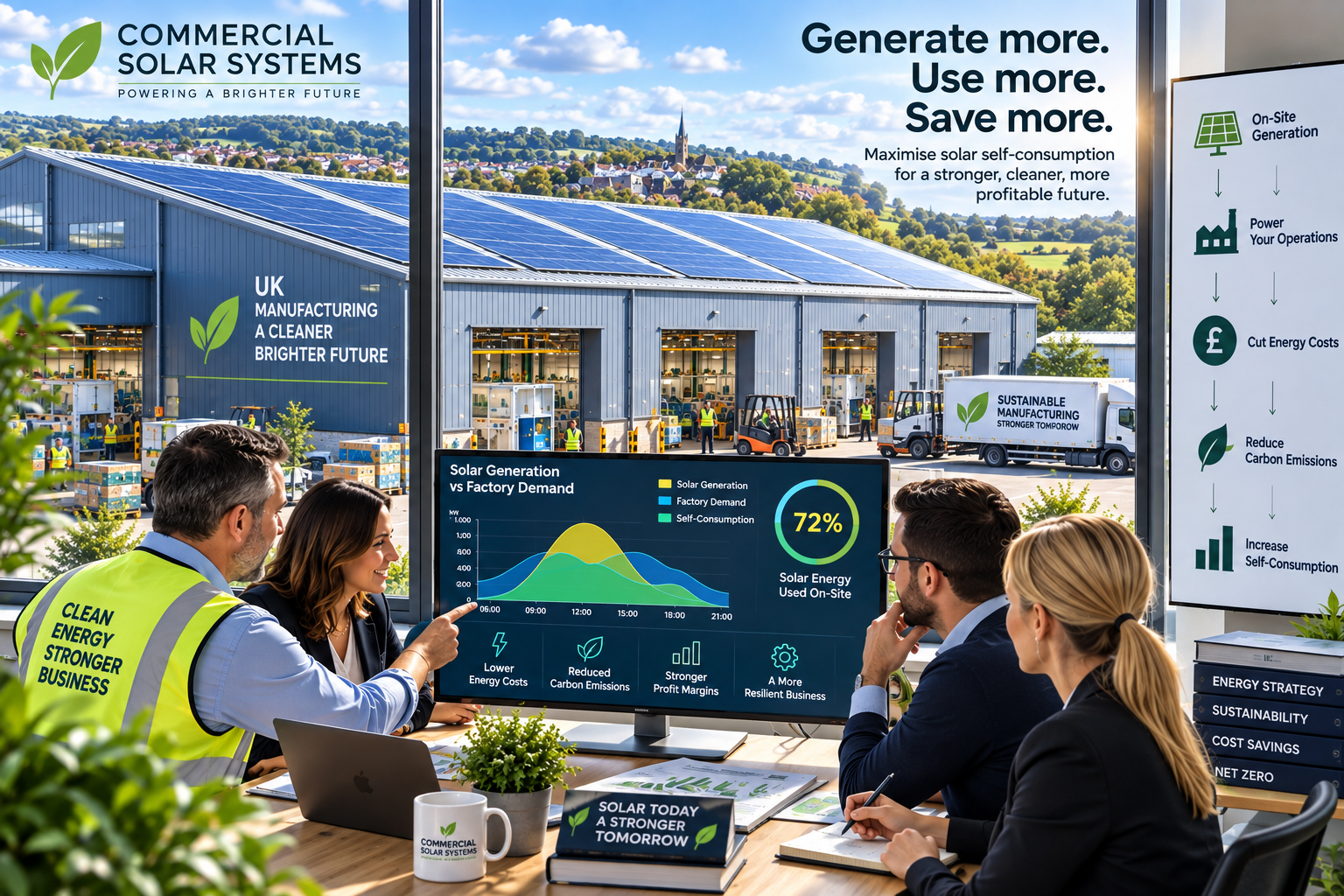
For many UK factories, the biggest commercial opportunity from rooftop solar is not simply generating as much electricity as possible. It is using as much of that solar electricity on site as possible.
This is known as solar self-consumption. When a factory consumes solar electricity at the point of generation, it reduces the amount of electricity that needs to be bought from the grid. For energy-intensive manufacturers with strong daytime loads, improving self-consumption can materially strengthen the financial case for commercial solar.
What is solar self-consumption?
Solar self-consumption is the proportion of electricity generated by a solar PV system that is used directly by the site rather than exported to the grid.
For example, if a factory’s solar array generates electricity while production lines, compressors, refrigeration, extraction, HVAC and other equipment are operating, much of that generation can be consumed immediately. The better the match between the site’s electricity demand and the solar generation profile, the greater the opportunity to reduce grid purchases.
This is why the correct starting point for a commercial solar project is not simply: How many panels can we fit on the roof? It is: How much electricity does the business use, when does it use it, and how much of that demand can solar economically replace?
Why self-consumption matters to UK manufacturers
Electricity generated and used behind the meter can offset electricity that would otherwise have been purchased from the grid. Electricity exported from the site may still have value, but the economics are different.
That makes load matching particularly important for factories. Manufacturing businesses often operate during daylight hours and can have relatively predictable electrical loads, giving them characteristics that can suit rooftop solar extremely well.
The UK Government reported in August 2026 that rooftop solar was helping drive record installation levels, accounting for more than seven in ten UK solar installations during July. The direction of travel is clear: businesses are increasingly looking at their roofs as productive energy assets.
1. Start with half-hourly electricity data
A good commercial solar design should be based on evidence. Half-hourly electricity data can reveal when a factory’s demand rises, falls and peaks across working days, weekends and seasons.
That demand profile can then be compared with expected solar generation. The objective is to identify a system size that provides a strong commercial return rather than automatically filling every available square metre of roof.
Our guide to correctly sizing a commercial solar installation explains why system sizing should reflect the site’s real electricity requirements.
2. Match energy-intensive processes to solar generation
Where operationally practical, manufacturers can improve self-consumption by considering when flexible electrical loads run.
- compressed-air systems;
- chillers and refrigeration;
- pumps and motors;
- HVAC and extraction;
- EV or forklift charging;
- water heating and other controllable electrical processes.
This does not mean allowing solar generation to dictate production. Instead, the energy profile can become another input into operational planning. Where a flexible process can economically be moved into a stronger solar-generation period, more electricity may be consumed on site.
3. Avoid oversizing the system purely to maximise panel numbers
A large factory roof can be tempting. But the largest possible array is not automatically the best commercial solution.
If a system regularly generates substantially more electricity than the factory can use, a greater proportion may be exported. Export can form part of the business case, but the value of exported electricity should be modelled separately from the value of electricity used on site.
For manufacturers, the aim should be to optimise the relationship between roof area, annual consumption, daytime demand, generation, export, project cost and financing.
4. Could battery storage increase self-consumption?
Battery storage can shift electricity from one period to another. Excess solar electricity generated during the day can potentially be stored and used later when site demand remains but solar output has fallen.
Government energy policy also recognises the role of batteries in storing electricity when it is plentiful and using it at periods of higher demand. However, a battery is not automatically the right answer for every factory. Its commercial value depends on the site’s load profile, surplus generation, tariffs, battery utilisation, expected lifetime and total installed cost.
Read our existing guide: Battery storage for a factory – is it worth it?
5. Consider future electricity demand before finalising the design
A solar system should not be designed only around yesterday’s electricity bill. Manufacturers should consider credible future changes such as additional production equipment, electrification of heat, EV fleets, electric forklift charging, extended shifts or planned factory expansion.
A business expecting electricity demand to increase may justify a different solar design from a business whose consumption is stable or declining.
6. Connect solar self-consumption to energy management
For manufacturers already working with energy audits, ESOS, SECR or ISO 50001, solar generation should not sit in isolation. Generation, consumption and savings can form part of the same energy-management picture.
Our article on linking energy audits to onsite solar explains how identified energy opportunities can feed into renewable-energy investment decisions.
A practical self-consumption checklist for factory owners
- Obtain at least 12 months of electricity-consumption data where available.
- Analyse half-hourly demand rather than relying only on annual totals.
- Assess usable roof area, orientation, condition and structural considerations.
- Model expected solar generation against the factory’s operating profile.
- Separate the financial value of self-consumed electricity from exported electricity.
- Consider whether flexible loads can move into solar-generation periods.
- Model battery storage only where the load and generation profile supports it.
- Allow for credible future increases or decreases in electricity demand.
- Compare cash purchase, asset finance and other appropriate commercial structures.
Frequently asked questions
What is a good solar self-consumption rate for a factory?
There is no universal percentage that is right for every factory. The commercially appropriate level depends on the site’s demand profile, system size, electricity price, export arrangements and financing. A site-specific model is more useful than a generic target.
Do factories need battery storage to maximise solar savings?
Not necessarily. A factory with high and consistent daytime demand may already consume a large proportion of its solar generation directly. Storage should be assessed on its own economics rather than automatically added to every project.
Should we cover the entire factory roof with solar panels?
Not automatically. Available roof area is only one design factor. Electricity consumption, load timing, export assumptions, roof condition, electrical infrastructure and financial objectives should all influence the final system size.
Turn your factory roof into a productive energy asset
Commercial Solar Systems specialises in solar solutions for UK factories and industrial businesses. We can assess your electricity profile, roof and commercial objectives to help establish an appropriately sized solar solution.
Explore our solar panels for factories guide or call 0333 888 0607 to discuss your site.
Sources: UK Government solar installation data and Clean Power 2030 battery-storage guidance. Information is general and project economics depend on site-specific circumstances.