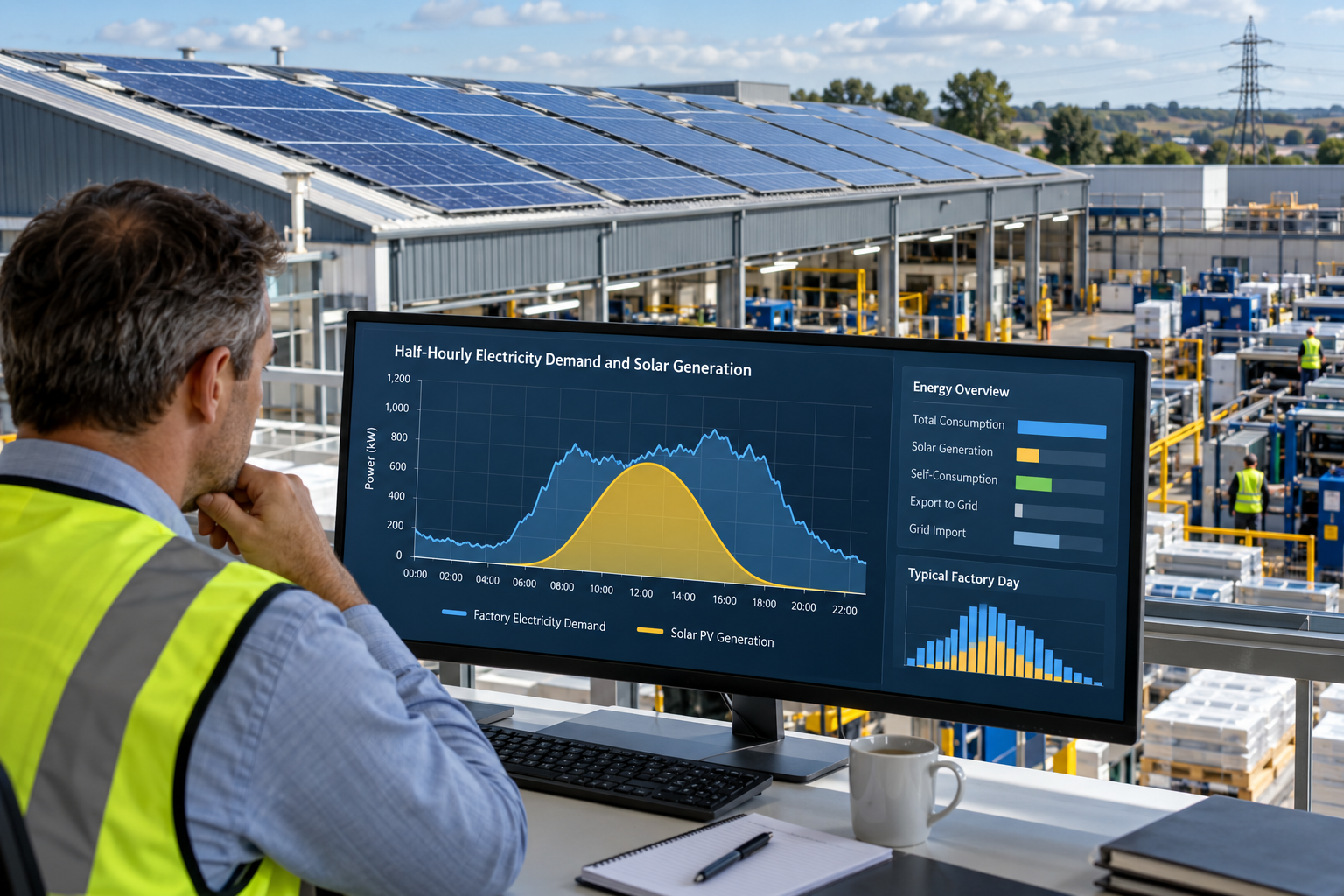
Factory solar is often discussed in terms of panel numbers and headline savings. For UK manufacturers, the better starting point is a practical question: how much electricity does the factory use while solar panels are generating?
A strong business case brings together half-hourly consumption, roof suitability, grid connection, installation risk and finance. Here is a practical checklist for factory owners, operations directors and finance teams.
1. Start with real electricity demand
Request at least 12 months of half-hourly electricity data and compare weekdays, weekends, production shifts and seasonal demand. Solar generation rarely matches a factory’s peak demand perfectly, so sizing should focus on realistic on-site consumption and export assumptions. Read our factory solar sizing guide.
2. Check the roof before estimating savings
Roof age, structural capacity, condition, access routes, shading, asbestos considerations and future maintenance can all affect project viability. A structural assessment and appropriate design review should come before any firm installation commitment. See our factory roof suitability checklist.
3. Plan grid connection early
Large rooftop installations may need distribution network operator (DNO) assessment and an appropriate G99 connection process. Export limits, reinforcement costs or timescales can influence the design and financial model. Our DNO and G99 guide explains the issues.
4. Treat safety and insurance as design requirements
Ask prospective installers about electrical design, safe isolation, fire-risk management, maintenance access, roof warranties and insurer requirements. These are not matters to leave until commissioning. Review our factory solar fire-safety checklist.
5. Compare funding on total lifetime value
Buying outright, asset finance and power purchase agreements (PPAs) can create different cash-flow and risk profiles. Compare maintenance responsibilities, contract length, tariff escalation, export income, ownership and exit terms. See our PPA versus buying guide and solar funding overview.
6. Consider battery storage only where the data supports it
Batteries may help shift solar generation into later demand periods, but their economics depend on load patterns, tariffs, usable capacity, cycling, losses and capital costs. Standard grid-connected solar and batteries do not automatically provide power during an outage: backup operation requires a specifically designed and approved system. Read our factory battery-storage guide.
7. Build a decision-ready business case
Ask for a site-specific model showing annual generation, on-site use, export, installation and maintenance costs, funding assumptions, expected carbon impact and sensitivity to electricity prices. Savings and payback are projections, not guarantees. Where tax relief is considered, obtain advice on applicable UK capital allowances rather than assuming an automatic deduction.
What should a factory do next?
Start with your electricity data and a roof review. Then commission a design and financial assessment that incorporates grid constraints, safety and financing. A well-planned project is more valuable than an oversized system built around optimistic assumptions.
Want to assess your factory’s potential? Contact Commercial Solar Systems to discuss a practical, site-specific assessment.