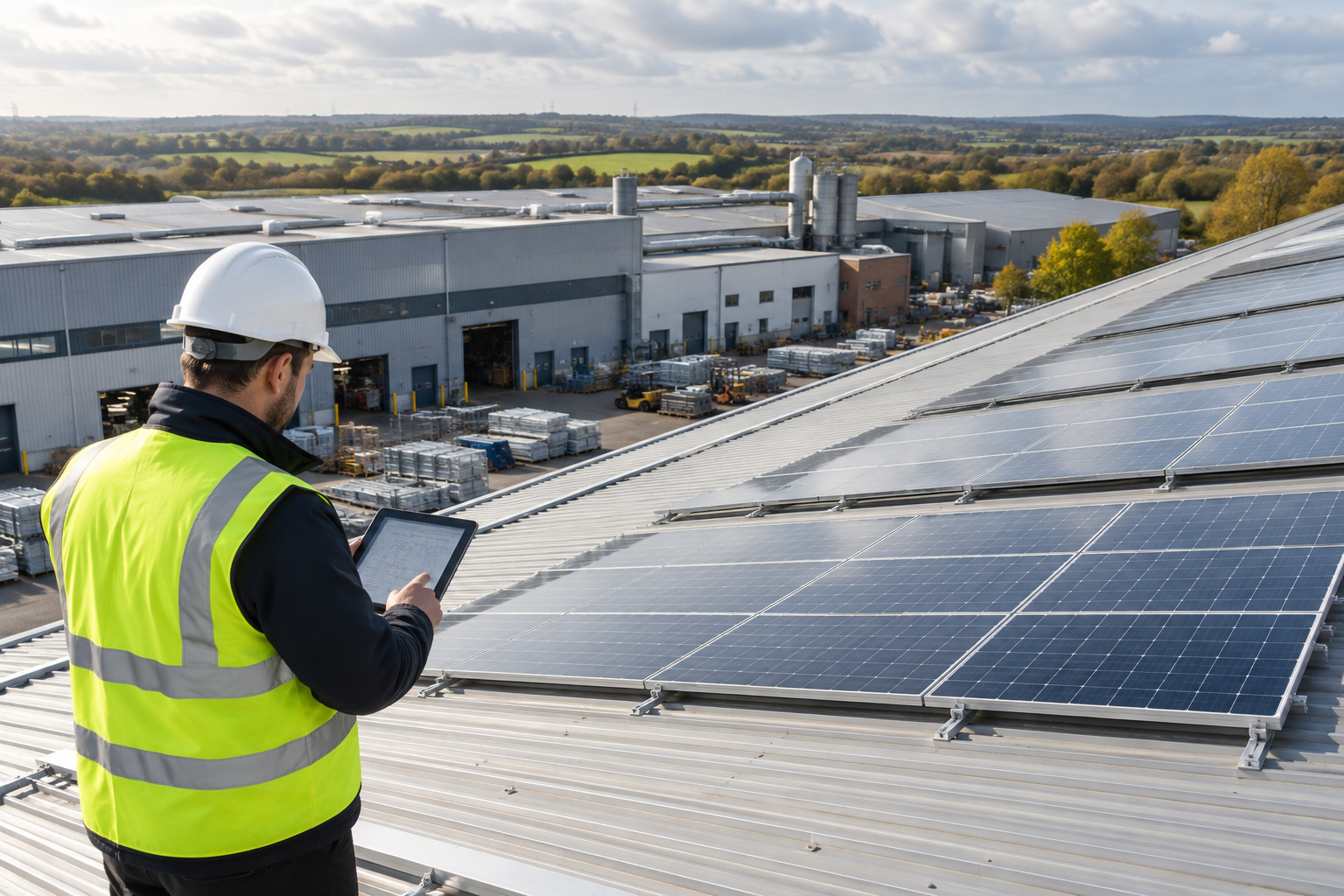
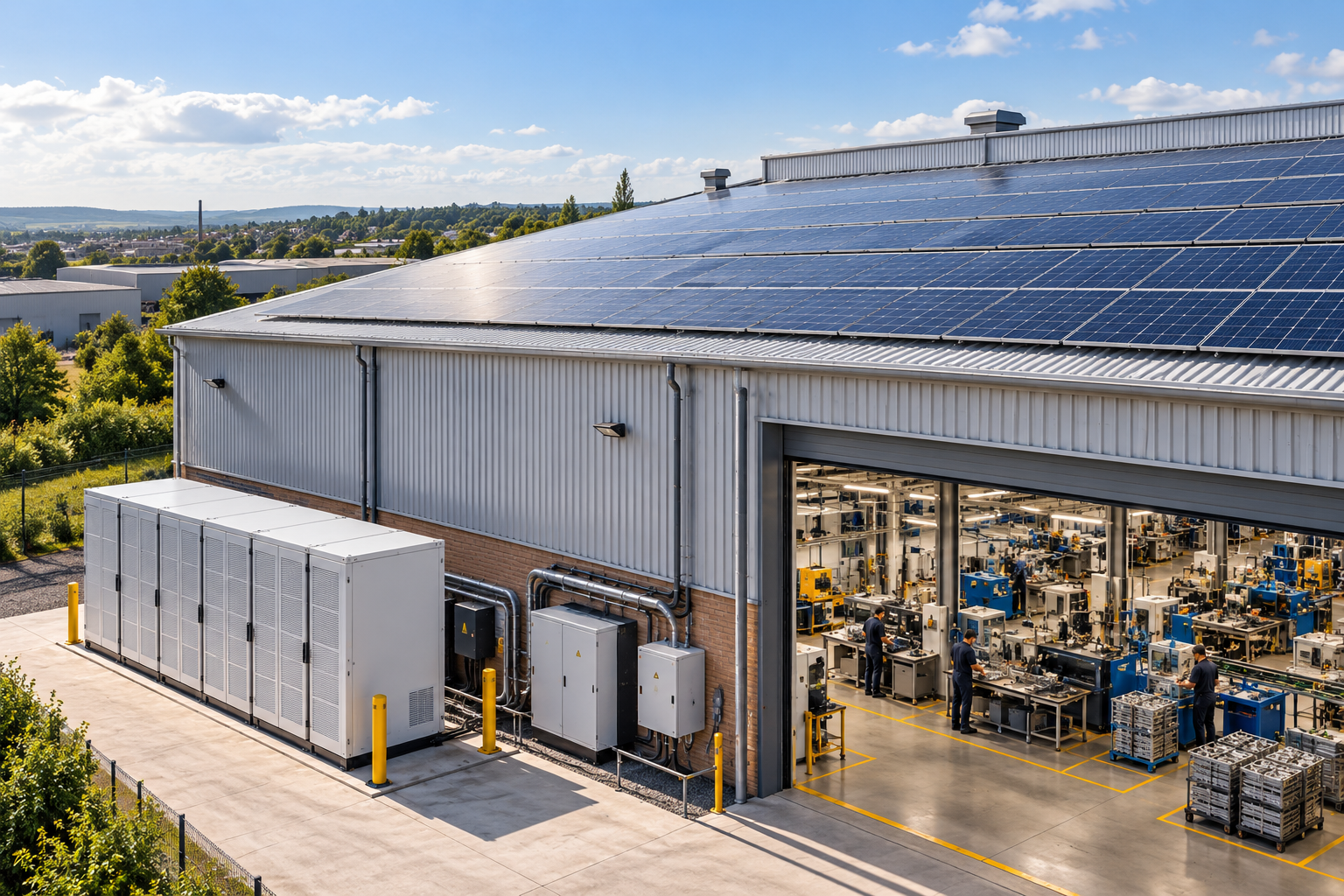
Battery storage can strengthen a factory solar project, but it should not be treated as an automatic add-on. For many UK manufacturers, daytime production already consumes a high proportion of solar generation directly. The commercial case for a battery depends on what happens to electricity across the whole working day: when the factory imports from the grid, when solar is exported, how shifts operate and what electricity costs at different times.
This guide explains when battery storage for factory solar can make commercial sense and the information manufacturers should examine before deciding on capacity.
Start with the factory’s half-hourly electricity data
The first step is to understand the site’s consumption profile. Half-hourly data can show whether electricity demand already overlaps strongly with expected solar generation, whether meaningful surplus occurs around midday and whether substantial demand continues after solar output falls.
For the wider solar business case, see our solar panels for factories UK guide.
When can battery storage add value?
A battery may deserve closer modelling where a factory regularly exports useful amounts of surplus solar, operates evening or night shifts, experiences costly short-duration demand peaks, or can benefit from moving electricity consumption between different tariff periods. The relevant value streams depend on the individual site’s tariff, operating pattern, equipment and connection arrangements.
Solar self-consumption versus export
Electricity used directly by factory machinery does not need to be stored first. That is why good solar sizing remains important even when batteries are being considered. Manufacturers should establish how much generation can be consumed onsite, how much is likely to be exported and whether storing some of that surplus produces a better return after battery costs and losses are included.
Our guides to factory solar self-consumption and surplus factory solar electricity explain these two parts of the calculation in more detail.
Battery storage for factories with later shifts
A manufacturer whose electricity demand continues into the evening may have a different storage opportunity from a single-shift daytime factory. Surplus solar generated earlier in the day could potentially be stored for later use, but the battery should be sized against real demand and realistic solar surplus rather than simply the total capacity of the PV array.
Can batteries help with factory peak demand?
Some industrial sites experience sharp peaks when energy-intensive equipment starts or several processes operate simultaneously. Depending on the site’s tariff and electrical characteristics, storage may be able to reduce certain grid-import peaks. This requires detailed modelling because battery power (kW), stored energy (kWh), controls and the duration of the peak all matter.
Do not oversize the battery
A larger battery is not automatically a better investment. Capacity that is rarely used adds capital cost without necessarily adding equivalent savings. The design should model expected charge and discharge cycles, usable capacity, efficiency, degradation assumptions and the manufacturer’s operating schedule.
Solar first or solar and battery together?
Both approaches can be valid. A manufacturer can assess solar and storage together from the outset, or design the solar system so storage can be considered later. What matters is that the solar project remains commercially sound in its own right and that the incremental cost and benefit of storage are visible rather than hidden inside one headline return figure.
Factory solar battery checklist
- Review at least representative half-hourly electricity consumption data.
- Model expected solar generation and direct onsite consumption.
- Quantify likely surplus solar and grid imports by time of day.
- Consider production shifts and planned operational changes.
- Review electricity tariff structure and relevant demand charges.
- Define what the battery is intended to achieve before choosing capacity.
- Model battery kW and kWh requirements separately.
- Include efficiency, degradation, warranty and replacement assumptions.
- Compare solar-only and solar-plus-storage financial cases.
Frequently asked questions
Does every factory solar installation need a battery?
No. Factories with strong daytime demand may consume a large share of solar generation directly. Battery storage should be justified by the site’s consumption, export, tariff and operational data.
Can a factory battery store surplus solar for a night shift?
Potentially. The amount that can economically be shifted depends on daytime surplus, evening demand, battery capacity, efficiency and the relative value of electricity at different times.
Should battery capacity match the solar-panel capacity?
Not necessarily. Solar is normally expressed in kWp, while battery design must consider both power in kW and energy capacity in kWh. The appropriate relationship depends on the site’s load profile and the job the battery is intended to perform.
Model the battery as a separate investment decision
For UK factories and manufacturers, the strongest approach is to design solar around the building and electricity demand, then quantify what battery storage adds. Commercial Solar Systems can help assess your consumption profile, rooftop solar opportunity and storage options. Contact us to discuss your factory energy project.