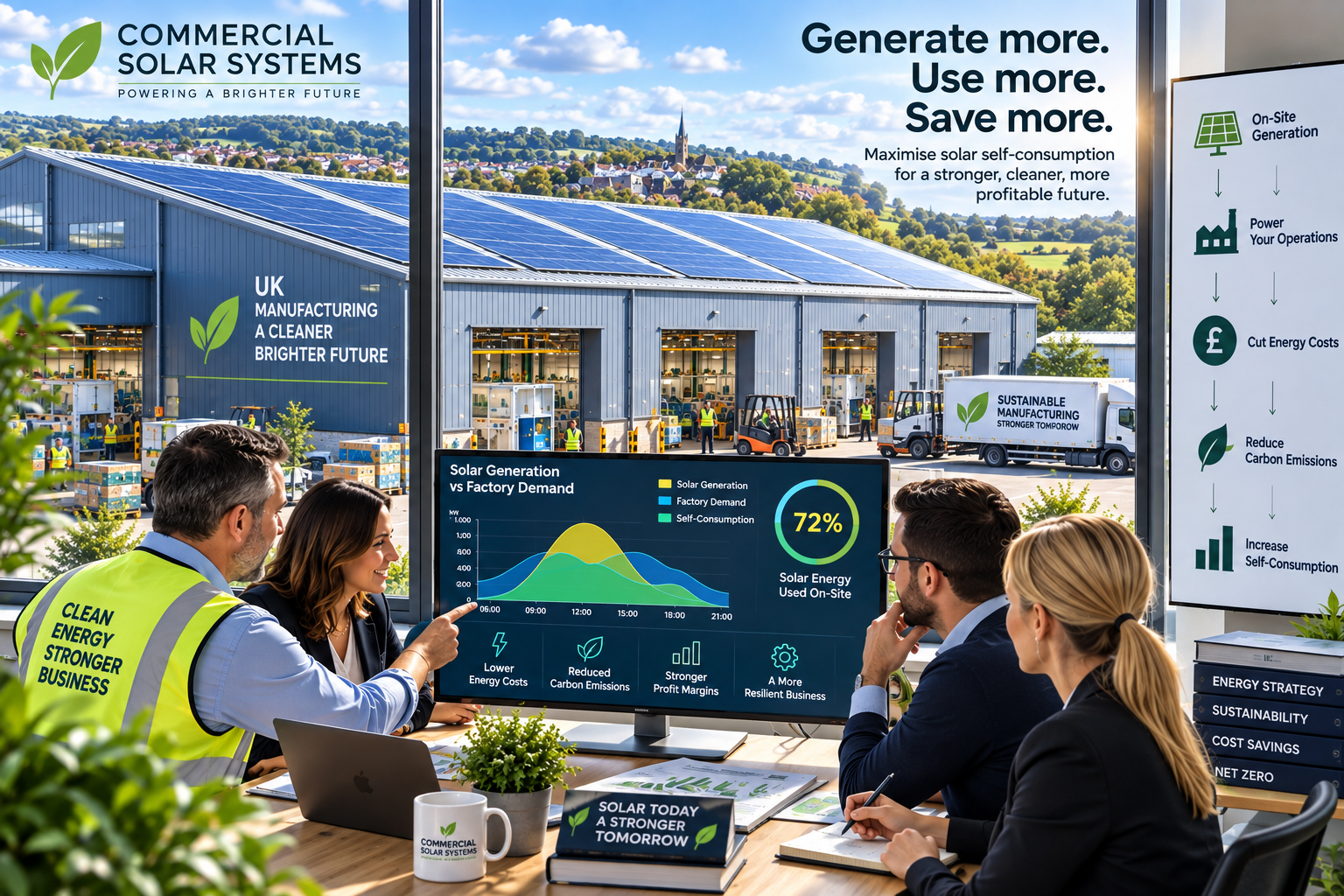

For a UK factory considering commercial solar, one of the most important questions is what happens when the panels generate more electricity than the site can use at that moment.
The answer is that surplus electricity can potentially be exported to the grid. But for most manufacturers, export should be treated as the second part of the strategy. The first priority is normally to maximise the value of the solar electricity used directly behind the meter.
What happens to surplus solar electricity from a factory?
Rooftop solar generates electricity whenever irradiance is sufficient. The factory consumes that electricity first. If generation exceeds the site’s instantaneous demand, the surplus can flow through the site’s metering arrangement and, subject to the connection and export arrangements in place, be exported to the distribution network.
This makes factory solar fundamentally different from thinking only about annual generation. A manufacturer needs to understand three separate figures: total solar generation, solar electricity consumed on site and electricity exported.
Why self-consumption normally comes first
Electricity used directly by the factory replaces electricity that would otherwise have been purchased from the grid. Exported electricity is instead sold under whatever export arrangement the business has secured.
That is why the commercial design objective is rarely simply “fill the roof”. The stronger approach is to model the factory’s half-hourly demand against expected solar generation and establish the balance between self-consumption and export.
Our recent guide to factory solar self-consumption explains how manufacturers can increase the proportion of solar generation used on site.
Can UK businesses be paid for exported solar electricity?
Yes, eligible generators can potentially receive payment for electricity exported to the grid. The Smart Export Guarantee (SEG) requires participating licensed electricity suppliers to offer export tariffs to eligible generators, although suppliers determine their own tariff rates and contractual terms.
Ofgem publishes the current list of SEG licensees and explains that SEG tariff rates must be above zero. Businesses should confirm eligibility, metering requirements, system capacity limits and commercial terms directly with prospective export providers before relying on export revenue in an investment case.
Official guidance: Ofgem Smart Export Guarantee.
Export income should not rescue a badly sized solar system
A large industrial roof can tempt a business to specify the maximum possible PV capacity. That may be appropriate in some cases, particularly where future electricity demand is expected to increase or an attractive export arrangement is available. But it should be the result of modelling rather than an assumption.
A well-designed proposal should examine the site’s consumption profile, operating hours, roof capacity, network constraints, import tariff, expected export profile and future plans. Read our guide to correctly sizing a commercial solar installation.
How half-hourly data reveals the export opportunity
Annual electricity consumption alone cannot show when surplus generation is likely. Half-hourly data allows expected PV output to be compared with factory demand throughout the working day and across the year.
- How much solar electricity is likely to be consumed immediately?
- At what times could generation exceed factory demand?
- How much electricity might be exported?
- Would shifting flexible loads improve self-consumption?
- Could future electrification increase daytime demand?
- Is battery storage worth modelling against the remaining surplus?
Could battery storage reduce solar exports?
Potentially. A battery can store some surplus solar generation and make it available later, but this does not automatically mean storage produces the best financial return.
The business case depends on factors including surplus volume, battery capacity and power, cycling strategy, electricity tariffs and capital cost. Manufacturers should model the battery separately rather than assume every solar installation requires one. See our detailed guide: Battery storage for a factory – is it worth it?
Don’t forget the grid connection
Larger commercial solar projects require appropriate network assessment and connection arrangements. The amount a site is permitted to export can affect system design and the commercial model.
This is another reason to assess grid requirements early rather than treating export as an afterthought once the panels have been designed.
A practical factory-first solar strategy
For many manufacturers, the strongest sequence is straightforward: understand the factory’s electricity demand, size solar around the commercial objective, maximise valuable on-site consumption, quantify the genuine surplus, then assess the best available route for export or storage.
This factory-first approach keeps the investment focused on reducing purchased electricity while still recognising that genuine surplus generation can have value.
Frequently asked questions
Can a factory sell excess solar electricity back to the grid?
Potentially, yes. Eligibility and payment depend on the export arrangement, metering, connection conditions and supplier terms. Ofgem’s Smart Export Guarantee framework is one route for eligible generators.
Is it better to use solar electricity or export it?
For many factories, using solar directly is commercially attractive because it displaces purchased grid electricity. The correct comparison depends on the business’s import cost and the export tariff available.
Should we oversize our factory solar system to earn export income?
Not without modelling it first. Roof capacity, factory demand, export terms, network constraints and future consumption should all be considered before choosing system size.
Do we need a battery to export solar electricity?
No. Solar can be exported without a battery where the appropriate connection, metering and commercial arrangements are in place. Storage is a separate investment decision.
Find out how much solar your factory could use on site
Commercial Solar Systems specialises in commercial and industrial solar for UK businesses. We can assess your half-hourly consumption, roof potential and operating profile to help establish the balance between on-site solar use and genuine surplus generation.
Explore our solar panels for factories guide or call 0333 888 0607 to discuss your site.