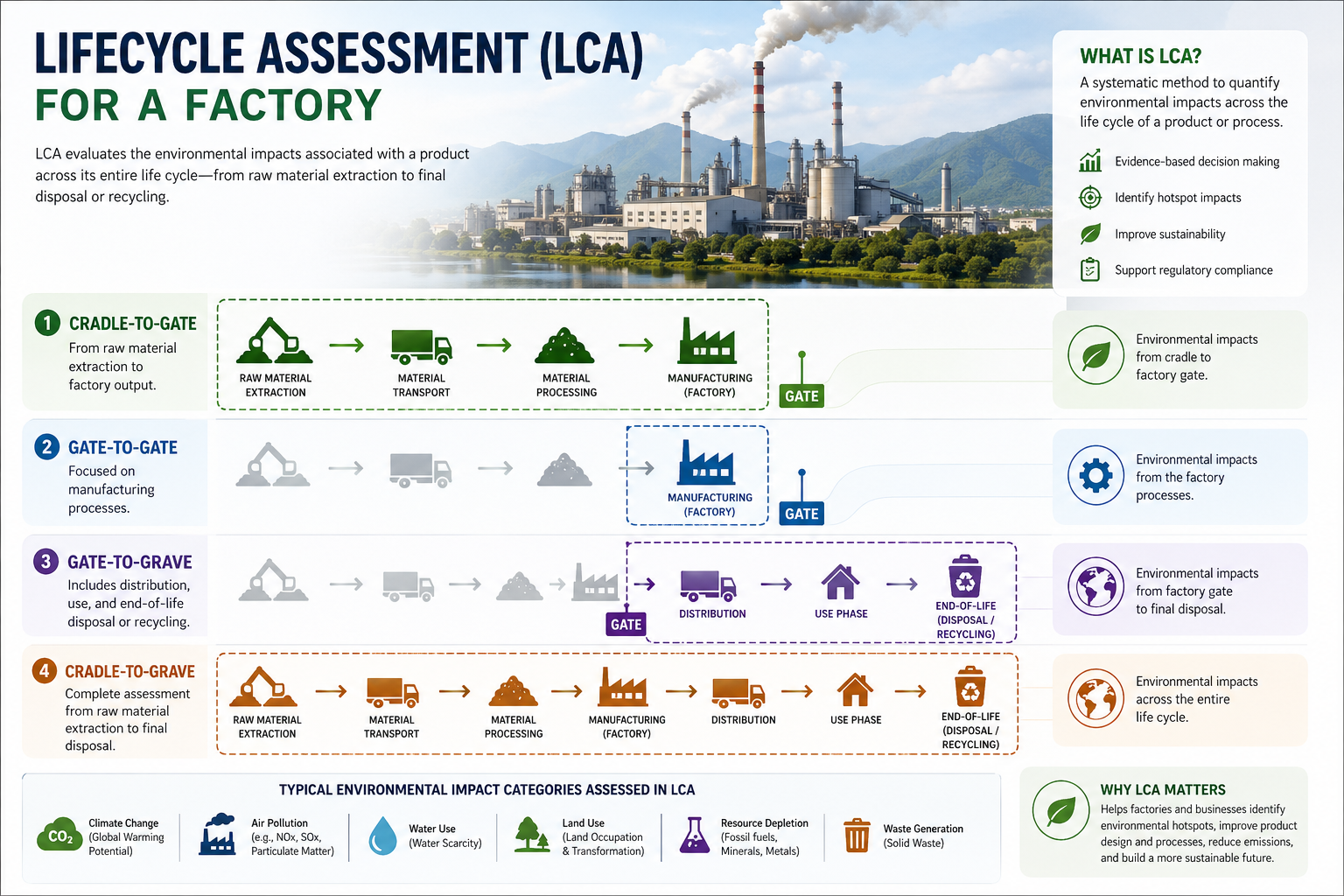
Product Carbon Foot Printing for manufacturing and engineering companies relies on Lifecycle Assessment (LCA), which examines emissions across every stage of a product’s life:
1. Cradle-to-gate:
From raw material extraction to factory output
2. Gate-to-gate:
Focused on manufacturing processes
3. Gate-to-grave:
Includes distribution, use, and end-of-life disposal or recycling
4. Cradle-to-grave:
Complete assessment from raw material extraction to final disposal
For most UK factories, the most immediate opportunities to reduce carbon are in the cradle-to-gate stage lifecycle assessment phase – production processes, energy use, and material efficiency.
And as covered in our previous post – ISO 14067 and PAS 2050 are the two main standards for Product Carbon Foot Printing.
Key Principles of ISO 14067 / PAS 2050
Both standards emphasise:
1. Relevance:
Focus on emission sources that are significant and measurable
2.Completeness:
All relevant stages of the product lifecycle assessment are included
3. Consistency:
Methodologies, data sources, and assumptions are documented and repeatable
4.Transparency:
Assumptions and data sources are clearly reported
5. Accuracy:
Strive to reduce uncertainties and errors
6. Continual improvement:
Products should be reassessed as processes, materials, or suppliers change
These principles ensure that product carbon footprints are credible, auditable, and comparable.
Identifying Emission Sources
For manufacturers, typical emission sources in a product footprint include:
Raw materials:
1. Steel, plastics, chemicals, packaging
2. Supplier production methods and transport
Manufacturing:
1. Electricity, gas, compressed air, water
2. Equipment and process efficiency
3. Waste generation
Transport and logistics:
1. Distribution to customers
2. Refrigerated or temperature controlled transport
End-of-life:
1. Disposal, recycling, or incineration
2. Reuse or remanufacturing
Mapping these sources allows manufacturers to target the highest-impact areas first.
Additional Resource
If you’d like to learn more about ISO and other operational improvement / cost reduction related accreditations, please request a complimentary copy of our factories guide book – Planet meets Profit.