
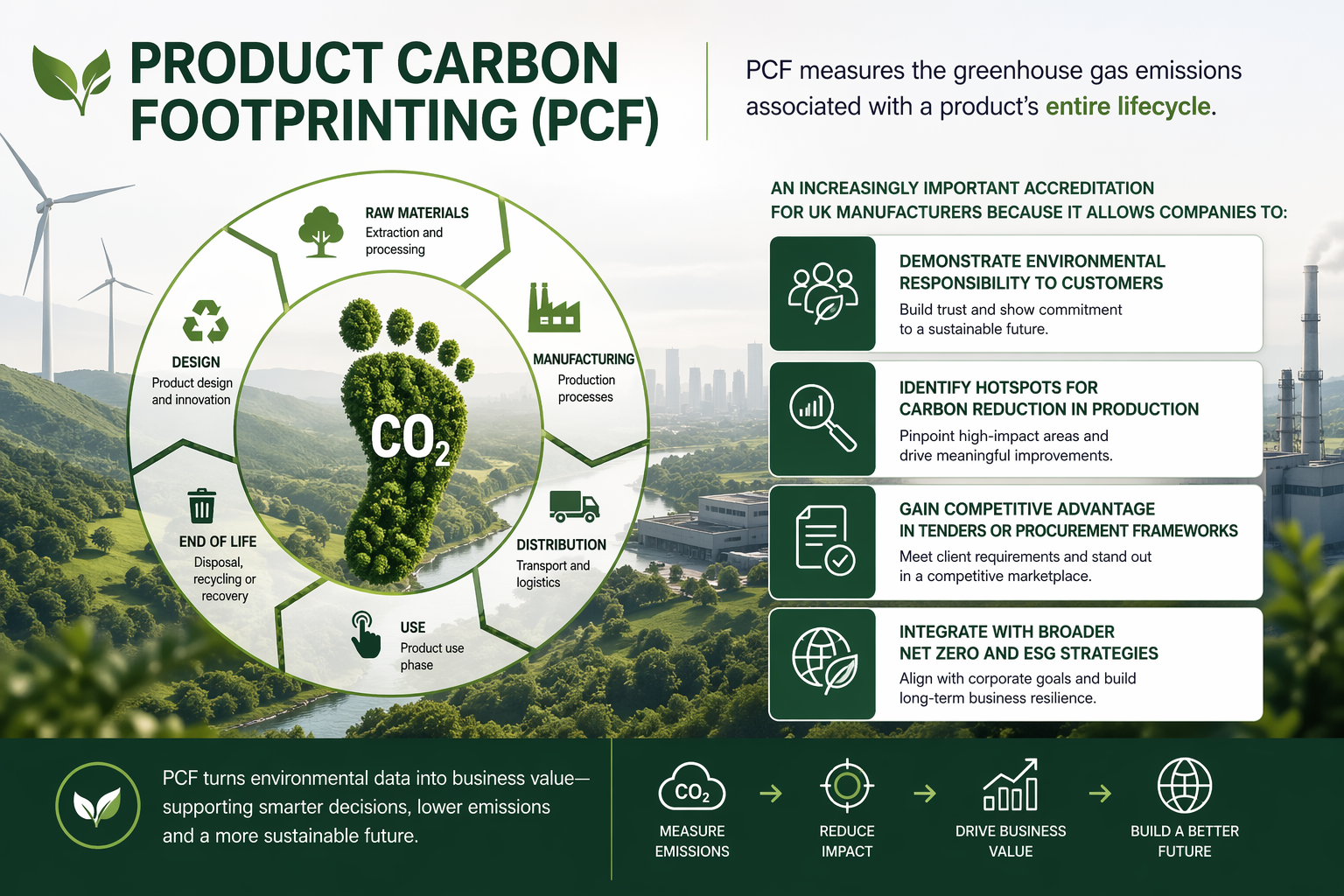
Product Carbon Foot Printing (PCF) measures the greenhouse gas emissions associated with a product’s entire lifecycle.
It’s an increasingly important accreditation for UK manufacturers because it allows companies to:
1. Demonstrate environmental responsibility to customers
2. Identify hotspots for carbon reduction in production
3. Gain competitive advantage in tenders or procurement frameworks
4. Integrate with broader net zero and ESG strategies
ISO 14067 and PAS 2050 are the two main standards for Product Carbon Foot Printing:
ISO 14067:
International standard specifying principles, requirements, and guidelines for quantifying and communicating the carbon footprint of a product
PAS 2050:
UK specific publicly available standard for life cycle Greenhouse Gas assessment of goods and services
Both standards align closely but differ slightly in terminology, scope, and communication requirements.
Why Product Carbon Foot Printing Matters
In the UK, product-level carbon foot printing is increasingly required in sectors such as:
1. Food and beverage
2. Construction and building materials
3. Automotive and transport components
4. Electronics and machinery
Reasons Product Carbon Footprinting is commercially significant:
Customer expectations:
Many large corporates now request verified product carbon data as part of tendering
Supply chain requirements:
Tier-1 manufacturers require Tier-2 suppliers to provide verified emissions data
Market differentiation:
Lower carbon products can command a price premium or preferential procurement
Internal improvement:
Identifying carbon hotspots often uncovers efficiency gains and cost reductions
Manufacturers that ignore Product Carbon Foot Printing risk exclusion from high-value contracts, even if organisational emissions are well managed.
Additional Resource
If you’d like to learn more about ISO and other operational improvement / cost reduction related accreditations, please request a complimentary copy of our factories guide book – Planet meets Profit.