
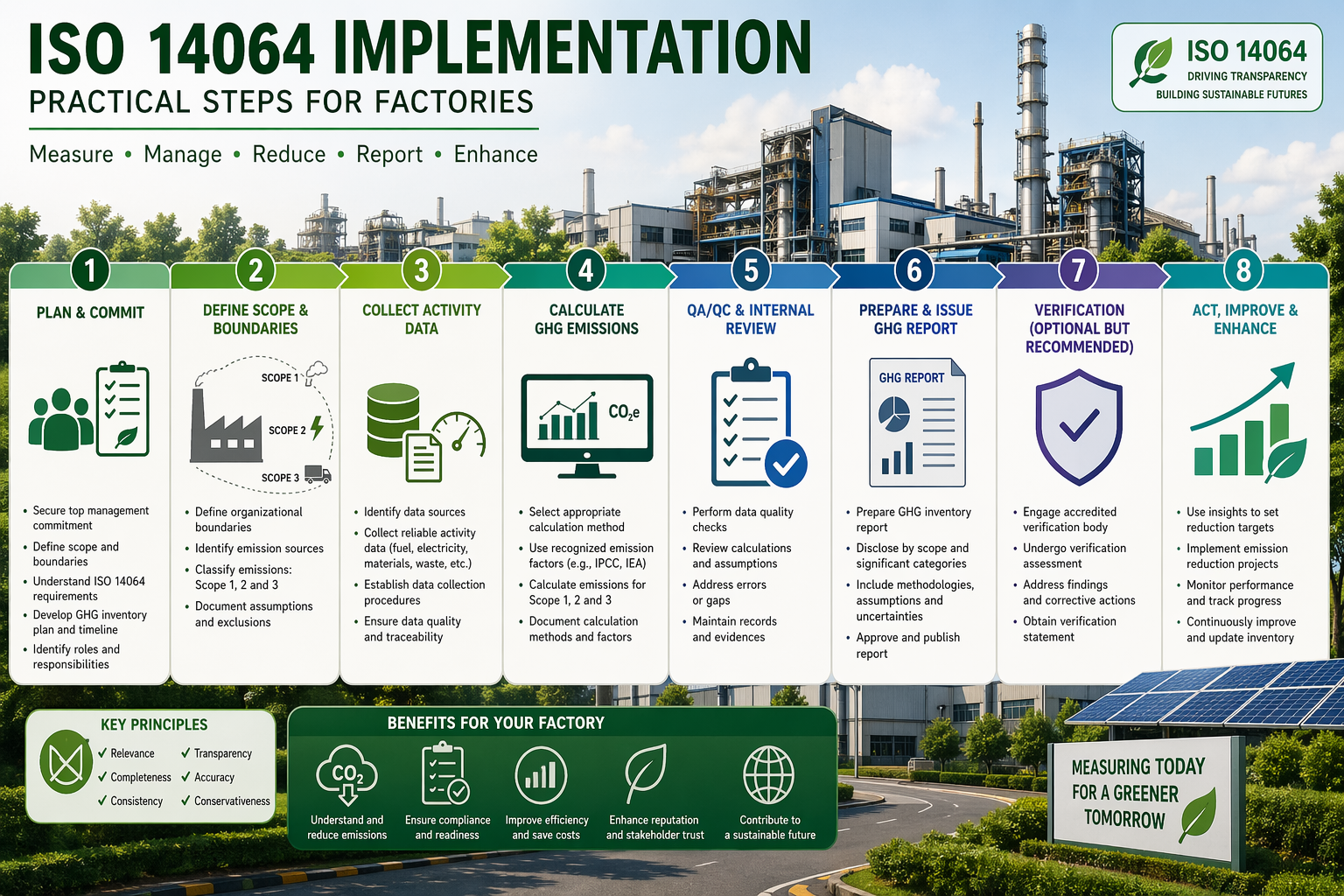
It’s alright talking to manufacturers about ISO 14046, but what are the practical steps for implementation, and how to integrate it with other carbon and energy schemes?
Practical Steps for ISO 14064 Implementation
1. Define organisational and operational boundaries
2. Identify and categorise Greenhouse Gas sources (Scope 1, 2, 3)
3. Collect activity data from meters, logs, and procurement records
4. Apply appropriate emission factors (DEFRA/BEIS recommended)
5. Calculate and report emissions in CO₂e
6. Review internally and integrate into management review
7. Arrange third party verification if required for tender or investor purposes
8. Use findings to plan reduction projects (e.g., energy efficiency, on-site renewables)
Integration with Other Carbon and Energy Schemes
ISO 14064 data supports or is required for:
1. SECR reporting – legally mandated Greenhouse Gas disclosures for UK companies
2. Carbon Trust standards and Route to Net Zero – independent carbon verification
3. Science-Based Targets (SBTi) – validated emission reduction commitments
4. PAS 2050 / ISO 14067 – product-level carbon foot printing
A well-executed ISO 14064 program makes participation in these schemes simpler, cheaper, and more credible.
14064 and Energy Efficiency Investments
Energy is typically the largest driver of Scope 2 emissions in manufacturing. ISO 14064 provides a direct business case for:
1. On site renewable energy schemes (solar PV, CHP)
2. Energy efficiency projects (lighting, motor drives, HVAC optimisation)
3. Continuous monitoring and performance improvement
Because ISO 14064 links energy use to verified carbon reductions, any savings or renewable generation is auditable and marketable, which can improve tender outcomes and investor confidence.
Common Implementation Timeline
1. Initial baseline inventory: 2 – 3 months
2. Data collection and calculation refinement: 1 – 2 months
3. Management review & improvement planning: 1 month
4. Optional verification: 1 – 2 months
Manufacturers with existing ISO 14001/50001 systems can often implement ISO 14064 more quickly due to shared data collection and operational controls.
Key Takeaways for Manufacturers
1. ISO 14064 provides a credible framework for Greenhouse Gas measurement and verification
2. It supports compliance, tender eligibility, and ESG reporting
3. Integration with ISO 14001 and ISO 50001 reduces duplication and cost
4. On-site energy and efficiency improvements provide both environmental and financial benefits
5. Verified Greenhouse Gas data strengthens market credibility and opens commercial opportunities
What Comes Next?
With organisational Greenhouse Gas data in place, manufacturers are positioned to:
1. Implement ISO 14067/PAS 2050 for product level carbon foot printing
2. Plan energy reduction initiatives strategically
3. Integrate renewable energy schemes to achieve measurable and auditable reductions
Our next series details – ISO 14067/PAS 2050 – Product Carbon Foot printing