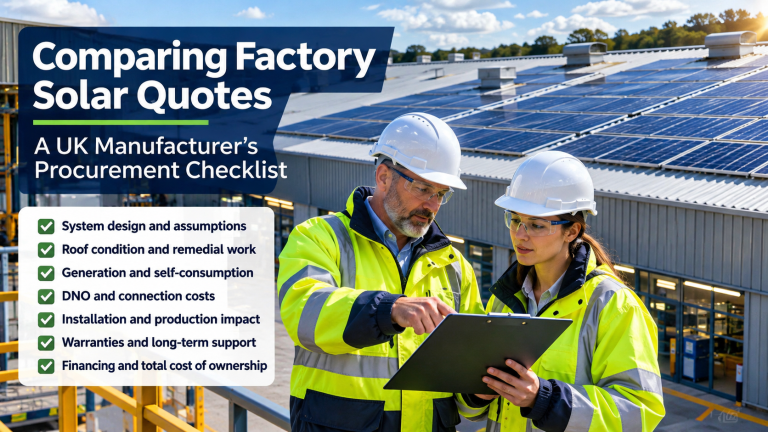

Every month you delay installing solar for factory roofs, you’re missing out on potential electricity savings. For a broader guide to system design, suitability and funding, see our solar panels for factories UK guide.
Before proceeding, assess the roof’s structural capacity, condition, safe access, existing roof materials and expected remaining service life. For related design risks, consult our factory solar fire-safety and insurance checklist. Savings from solar depend on site-specific technical and financial assumptions.
The longer you wait, the more you hand over to the energy companies instead of reinvesting that money into your business.
The Real Cost of Delay
Consider a factory spending £25,000 a month on electricity. The value of rooftop solar depends on when power is consumed, the solar generation profile, the electricity tariff, roof suitability, export arrangements and the installation cost.
A realistic financial appraisal compares forecast bill savings with maintenance, insurance and any finance repayments. An asset-finance proposal can be cash-positive where avoided electricity costs exceed repayments and other costs, but this is not guaranteed.
Use half-hourly electricity data and site-specific quotations rather than assuming every factory will save 70% of its electricity bill.
Stretch That Over the Long Term
Delaying a financially viable installation can postpone potential savings, but fixed claims about thousands of pounds lost every month do not apply to every factory.
Compare three scenarios: invest now, install after planned roof works, or defer. Model generation, on-site use, electricity prices, interest rates and maintenance costs in each scenario. Include the practical risks of disruption, grid connection delays and roof refurbishment.
Our solar panels for factories guide explains the wider technical and commercial checks.
Why the Urgency?
UK industrial electricity prices vary by contract, market conditions and consumption profile. A rooftop solar system may reduce the amount of electricity purchased from the grid during generating hours, but it does not fix the price of remaining imports.
Assess your current tariff, half-hourly consumption and realistic solar output before relying on a savings forecast.
Don’t Let Waiting Be Your Most Expensive Decision
There are few investments in business that offer the combination of:
✅ Potential reductions in purchased electricity
✅ Possible finance or rental options, subject to terms
✅ Long-term generation that can reduce exposure to grid prices
✅ Potential capital allowances, subject to eligibility
✅ Opportunities to improve on-site energy resilience
Factory rooftop solar may deliver attractive returns, but zero upfront cost, positive cash flow and tax relief are not guaranteed. Roof suitability, finance terms, electricity demand and project economics should be assessed individually.
Final Thought: Delay is the New Cost
Delaying a viable factory solar project may mean missing potential savings, but rushing a poorly specified installation can also be expensive.
Compare a realistic project cash-flow model against your current electricity costs, planned roof works and finance terms before deciding when to invest.