
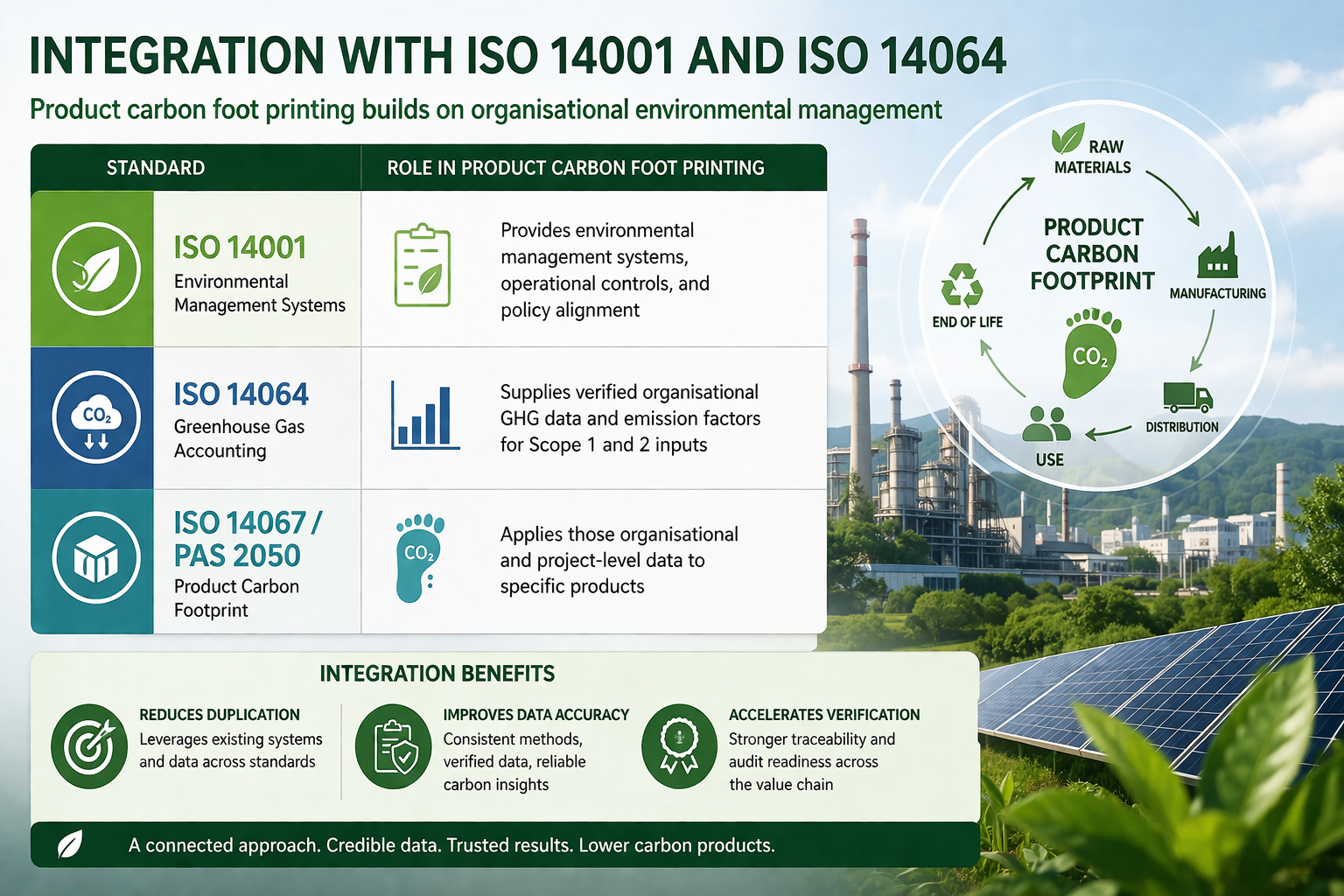
Why should manufacturing and engineering companies integrate ISO 14067 / PAS 2050 with ISO 14001 and ISO 14064?
Product carbon foot printing builds on organisational environmental management:
ISO 14001:
Provides environmental management systems, operational controls, and policy alignment
ISO 14064:
Supplies verified organisational GHG data and emission factors for Scope 1 and 2 inputs
ISO 14067 / PAS 2050:
Applies those organisational and project-level data to specific products
Integration reduces duplication, improves data accuracy, and accelerates verification.
Practical Steps for Manufacturing and Engineering Companies
1. Select product(s) for foot printing
2. Define system boundaries and lifecycle stages
3. Collect activity data and identify significant emission sources
4. Apply emission factors to calculate CO₂e
5. Document assumptions and methodology
6. Verify data internally and/or externally
7. Identify hotspots for reduction projects (energy, materials, logistics)
8. Update footprint regularly as production or materials change
Using Product Carbon Footprints to Win Business
Verified Product Carbon Footprints are increasingly differentiators in procurement and tendering:
1. Large retailers may require carbon footprint data before contract award
2. Construction clients evaluate embedded carbon in materials
3. Automotive OEMs ask Tier-2 suppliers for verified product CO₂e
By showing reduced footprint, manufacturing and engineering companies can gain access to premium contracts and position themselves as environmentally responsible partners.
Additional Resource
If you’d like to learn more about ISO and other operational improvement / cost reduction related accreditations, please request a complimentary copy of our factories guide book – Planet meets Profit.