
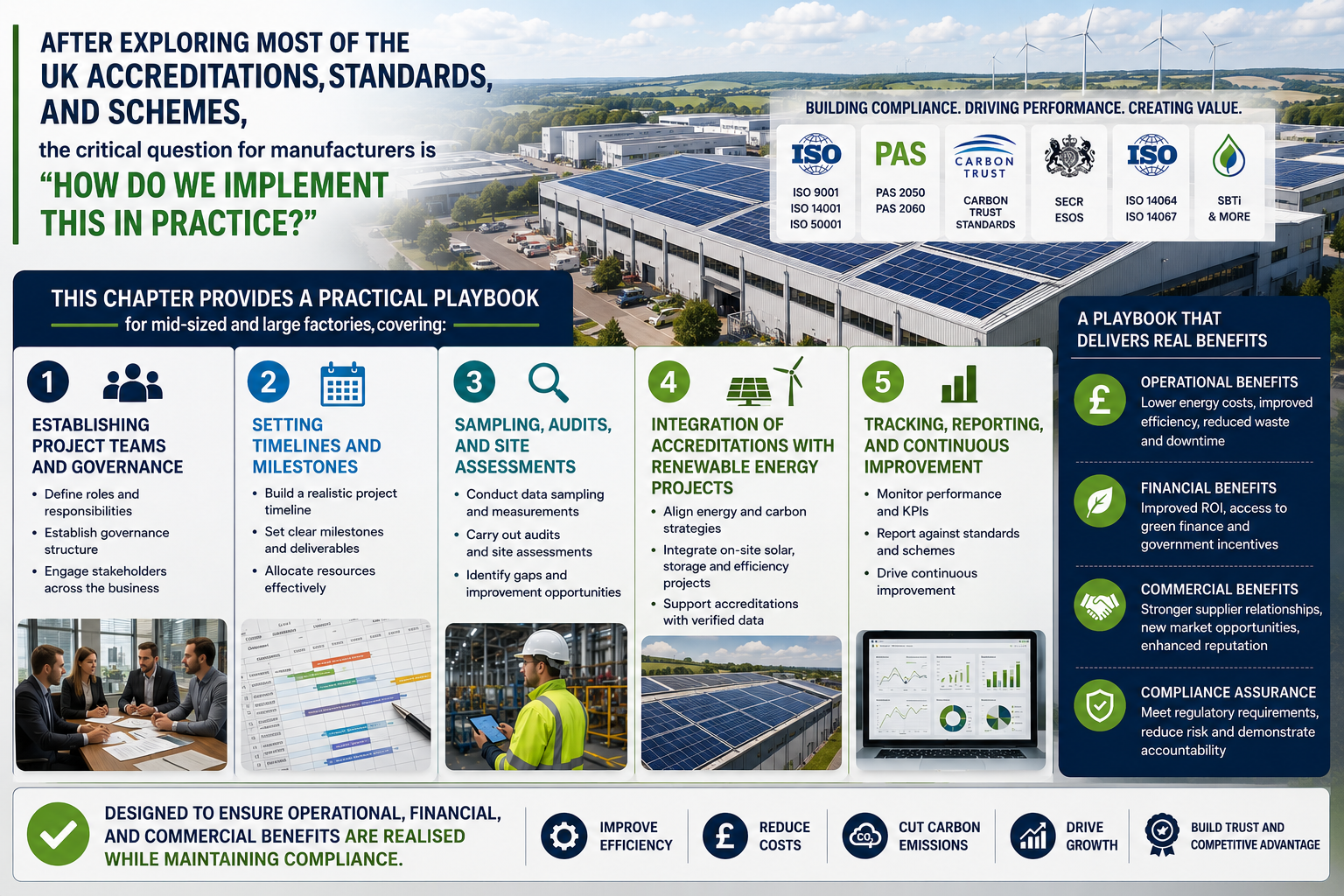
After exploring most of the of UK accreditations, standards, and schemes, the critical question for manufacturing and engineering companies is “how do we implement this in practice?”
This next educational series provides a practical playbook for factories, covering:
1. Establishing project teams and governance
2. Setting timelines and milestones
3. Sampling, audits, and site assessments
4. Integration of accreditations with renewable energy projects
5. Tracking, reporting, and continuous improvement
The playbook is designed to ensure operational, financial, and commercial benefits are realised while maintaining compliance.
And this first article will cover establishing a project team with governance.
Establishing a Project Team
A structured team ensures clarity of responsibilities and accountability.
Recommended roles…
1. Executive Sponsor:
Approves budget, aligns strategy with corporate goals
2. Project Manager:
Oversees implementation, timelines, and coordination
3. Energy Manager:
Leads ISO 50001, ESOS, SECR, and energy efficiency initiatives
4. Environmental Manager:
Oversees ISO 14001, ISO 14064, PAS 2060, Carbon Trust, EMAS
5. Procurement Lead:
Manages supply chain credentials, ISO 20400, responsible sourcing
6. Finance Lead:
Integrates cash positive solar projects, green finance, ROI tracking
7. Operations/Production Lead:
Coordinates site audits, energy saving measures, and sampling
8. Data & Reporting Lead:
Maintains dashboards, monitors KPIs, and ensures reporting accuracy
Tip:
For smaller factories, roles can be combined. For large factories with multiple sites, regional or site level leads may be necessary.
Look out for our next article which will cover ‘Setting Project Timelines’.
Additional Resource
If you’d like to learn more about operational improvement / cost reduction related accreditations, please request a complimentary copy of our factories guide book – Planet meets Profit.