For many UK manufacturers considering rooftop solar, planning permission is one of the first concerns. The good news is that many qualifying solar installations on non-domestic buildings in England can be carried out under permitted development rights, subject to specific limits and conditions.
That does not mean every factory can simply install panels without checks. Planning status, building type, location, roof structure, electrical requirements and the grid connection all need to be considered before work begins.
Do factories need planning permission for rooftop solar?
In England, the installation, alteration or replacement of solar photovoltaic or solar thermal equipment on many non-domestic buildings can fall within permitted development rights where the relevant conditions are satisfied.
This can simplify the planning route for suitable factories and warehouses. However, permitted development is not a universal exemption from planning control. The individual building and site still need to be checked against the applicable rules.
The former 1MW rooftop restriction has been removed
A particularly important change for larger commercial and industrial roofs is the removal of the previous 1 megawatt permitted-development limit for rooftop solar on non-domestic buildings in England.
This opened the permitted-development route to substantially larger rooftop systems where the other conditions are met. For energy-intensive manufacturers with large roof areas, that can remove a planning obstacle that historically affected bigger projects.
What conditions can affect permitted development?
The exact rules should be checked for each project. Factors can include how far equipment projects from the roof or wall, its position relative to the roofline, whether equipment is installed on a listed building or within its curtilage, and whether the site falls within certain protected or designated areas.
Planning Portal guidance also states that equipment should, so far as practicable, be sited to minimise its effect on the external appearance of the building and the amenity of the area, and should be removed when it is no longer needed.
Manufacturers should therefore establish the site’s planning position early rather than assuming that a large industrial roof automatically qualifies.
Listed buildings, conservation areas and sensitive sites
Additional restrictions can apply to listed buildings and particular designated locations. A factory occupying an older or historically significant building should not rely on the rules that may apply to a conventional modern industrial unit.
Where there is uncertainty, the relevant local planning authority or an appropriately qualified planning professional can confirm the position for the specific site.
Permitted development is not the same as Building Regulations approval
Planning and Building Regulations are separate regimes. A project that does not require a full planning application can still have Building Regulations and other compliance requirements.
Government guidance makes clear that permitted development rights do not remove the need to comply with other applicable legal requirements and consents.
The factory roof still needs a structural assessment
Planning status tells you whether development is permitted from a planning perspective. It does not tell you whether the roof is suitable for the proposed solar array.
A commercial solar project should consider roof condition, structural capacity, the proposed mounting solution, wind and other relevant design loads, access, drainage and the remaining life of the roof covering.
It can be expensive to install a large PV array and subsequently discover that major roof works are required. Roof condition should therefore form part of the early feasibility process.
Planning permission and the grid connection are different issues
A factory can have a suitable roof and a straightforward planning route but still need to address electricity-network requirements.
The Distribution Network Operator (DNO) process should be considered early for larger commercial systems. The permitted export capacity or connection requirements can influence the final design and commercial model.
This is particularly relevant where a factory expects to generate more electricity than it can consume at certain times. Our guide to factory surplus solar electricity and export explains this in more detail.
Could a factory car park also be used for solar?
Rooftops are not the only opportunity. England also has permitted-development provisions for certain solar canopies over non-domestic car parks, subject to their own limits and conditions.
For manufacturers with large employee or visitor car parks, solar canopies can potentially add generating area while providing a secondary use for existing land. They should be assessed separately from the rooftop installation because the design, planning conditions, structural requirements and electrical infrastructure differ.
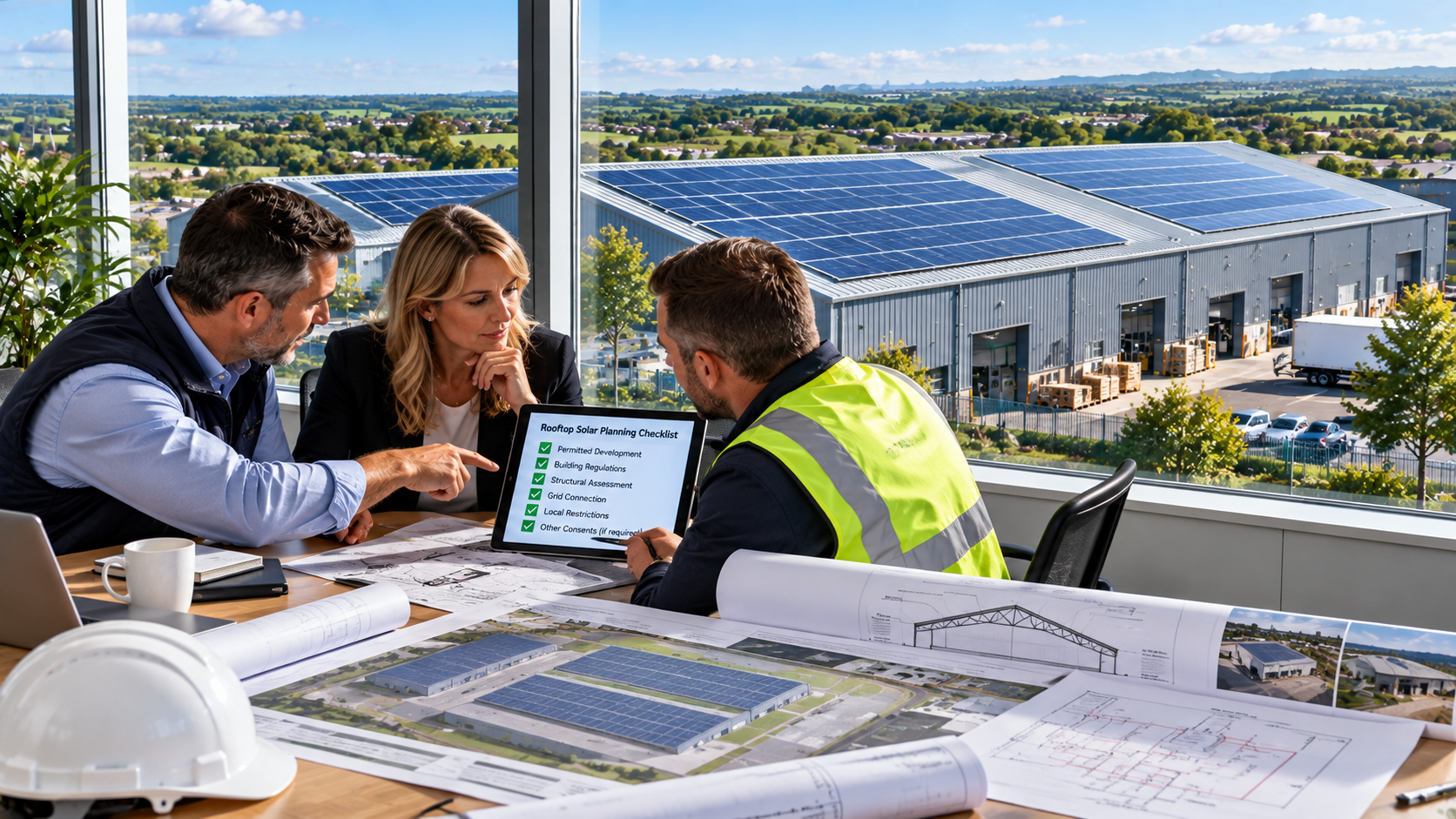
Eight checks before planning a factory solar installation
- Confirm ownership, lease and landlord requirements.
- Establish whether the proposed installation meets the applicable permitted-development conditions.
- Check for listed-building, conservation or other site-specific restrictions.
- Assess roof condition and structural suitability.
- Confirm Building Regulations and electrical compliance requirements.
- Start the DNO/grid-connection assessment at the appropriate stage.
- Analyse half-hourly electricity consumption before finalising system size.
- Coordinate installation access and works with factory operations and health-and-safety procedures.
For the sizing stage, see our guide to correctly sizing a commercial solar installation. Manufacturers planning the overall programme can also read how long it can take to get commercial solar panels onto a roof.
Planning should be an early check, not a reason to delay investigating solar
The important distinction is between identifying constraints and assuming constraints exist.
For many conventional industrial buildings in England, permitted development can make the planning route relatively straightforward. Where restrictions do apply, discovering them during feasibility gives the project team time to address them properly.
The commercial case should then be built around the factory’s actual electricity demand, roof potential and operating plans rather than around planning assumptions.
Frequently asked questions
Do commercial solar panels need planning permission in England?
Many installations on non-domestic buildings can qualify as permitted development when the relevant conditions are met. The specific property and proposal should still be checked before installation.
Is there still a 1MW permitted-development limit for factory rooftop solar?
The previous 1MW restriction for rooftop solar on non-domestic buildings in England was removed, allowing larger systems to use the permitted-development route where the remaining rules and conditions are satisfied.
Does permitted development mean Building Regulations do not apply?
No. Planning and Building Regulations are separate. Other legal, structural, electrical and safety requirements can still apply even where a full planning application is not required.
Can solar be installed on a listed factory building?
Listed buildings and their curtilage can be subject to additional restrictions and consent requirements. Site-specific professional advice should be obtained before proceeding.
Can factories install solar canopies over car parks?
Potentially. England has permitted-development rights for certain solar canopies on non-domestic car parks, subject to specific limitations and conditions. Each proposal should be checked individually.
Assess your factory roof before making assumptions about planning
Commercial Solar Systems specialises in solar solutions for UK factories and industrial businesses. A proper feasibility assessment can consider the roof, electricity profile, proposed system size and the practical steps required to move the project forward.
Explore our solar panels for factories guide or call 0333 888 0607 to discuss your site.
Planning rules vary across the UK and by site. This article provides general information and is not planning or legal advice. Check the current requirements applicable to your property before proceeding.