
This educational series has detailed how manufacturers and engineers are increasingly judged not only on their own carbon and environmental performance, but also on the sustainability of their supply chain.
Large buyers, retailers, and government agencies often demand verified supply chain carbon credentials as part of tender requirements and ESG reporting.
To support this we’ve provided educational content detailing:
1. ISO 20400 – Sustainable Procurement
2. PAS/BES standards for responsible sourcing
3. Buyer expectations and tender requirements
4. Strategies for integrating supply chain carbon credentials into operations
Our earlier articles covered ISO 20400 – Sustainable Procurement, PAS/BES Standards – Responsible Sourcing, and Buyer Expectations and Tender Requirements.
And our final topic today is…
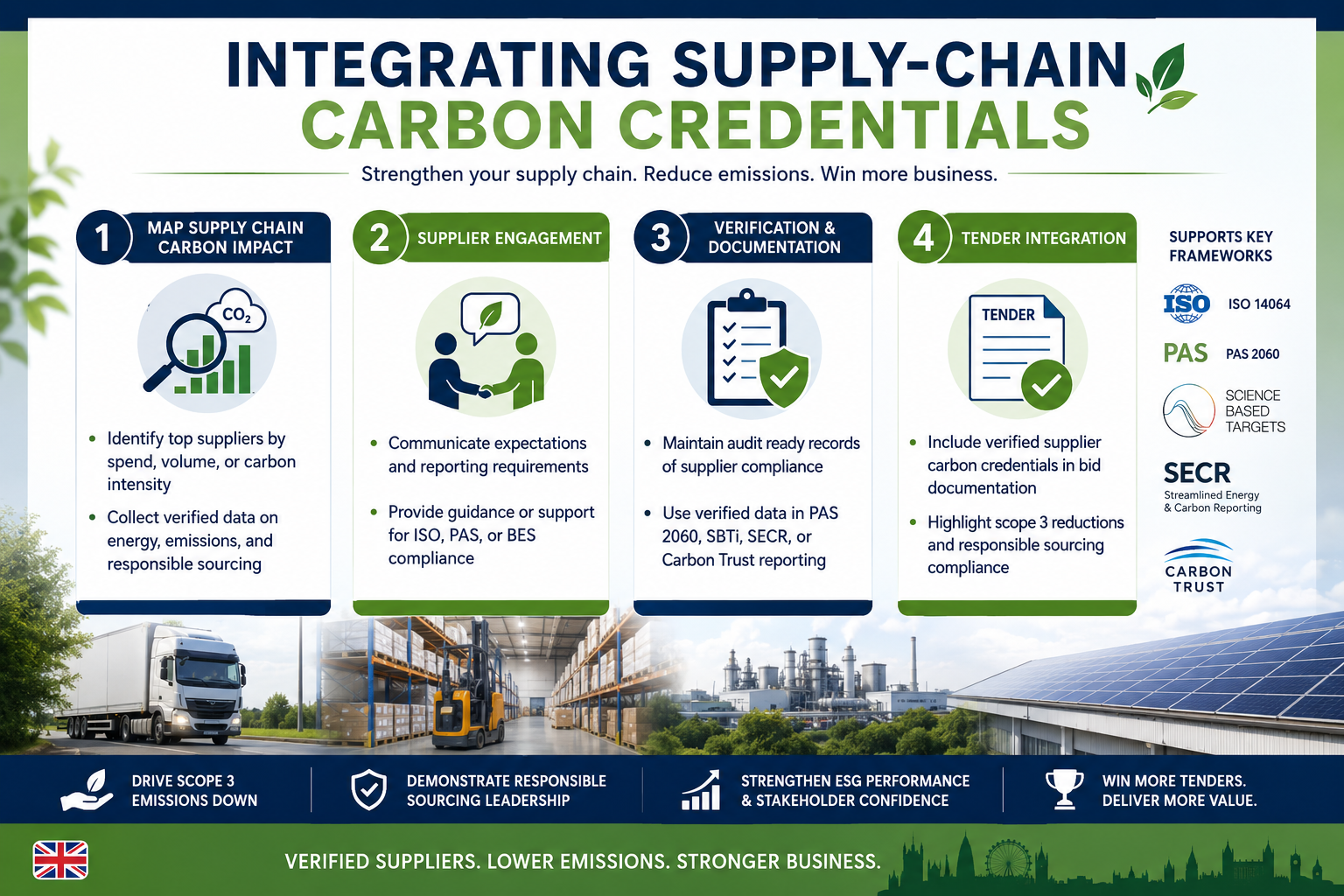
Integrating Supply Chain Carbon Credentials
Step 1: Map Supply Chain Carbon Impact
1. Identify top suppliers by spend, volume, or carbon intensity
2. Collect verified data on energy, emissions, and responsible sourcing
Step 2: Supplier Engagement
1. Communicate expectations and reporting requirements
2. Provide guidance or support for ISO, PAS, or BES compliance
Step 3: Verification & Documentation
1. Maintain audit ready records of supplier compliance
2. Use verified data in PAS 2060, SBTi, SECR, or Carbon Trust reporting
Step 4: Tender Integration
1. Include verified supplier carbon credentials in bid documentation
2. Highlight scope 3 reductions and responsible sourcing compliance
Benefits for UK Manufacturers
1. Tender competitiveness:
Verified supply chain credentials improve scoring in ESG, sustainability, and technical evaluation
2. Risk reduction:
Reduces risk of supplier non-compliance, reputational damage, or carbon exposure
3. Carbon neutrality:
Helps achieve PAS 2060 claims by addressing scope 3 emissions
4. ESG and investor confidence:
Demonstrates robust sustainability governance and supplier management
5. Operational efficiency:
Encourages suppliers to adopt energy and carbon efficiency measures
Common Challenges and Solutions
1. Lack of supplier data:
Implement structured data collection aligned with ISO 14064 and ISO 20400
2. Supplier resistance:
Provide guidance, training, and incentives for compliance
3. Complexity of verification:
Focus on key suppliers with highest carbon impact and material relevance
4. Integration with multiple accreditations:
Use integrated management system combining ISO, PAS, BES, Carbon Trust, and ESOS data
Addressing these challenges ensures manufacturers can deliver credible supply chain carbon credentials while minimising administrative burden.
Additional Resource
If you’d like to learn more about operational improvement / cost reduction related accreditations, please request a complimentary copy of our factories guide book – Planet meets Profit.