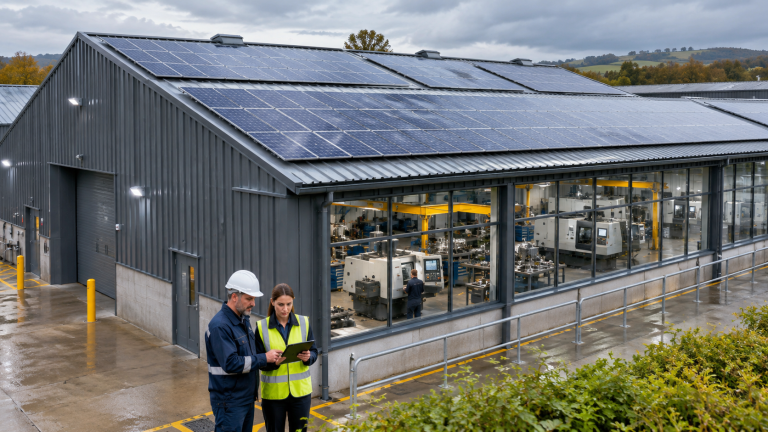
Renewing a factory electricity contract and investing in rooftop solar are two separate decisions—but they should be modelled together. A manufacturer that signs a new supply agreement without considering future onsite generation can misjudge import volumes, export arrangements and the commercial value of its roof.
This guide is for UK manufacturing finance directors, operations directors and engineering site managers preparing for an electricity contract renewal while assessing a commercial solar installation. It is a procurement planning guide, not legal or energy-supply advice.
Why the contract renewal date matters
A factory solar system changes the amount of electricity imported from the grid during sunny production hours. It does not necessarily change overnight demand, fixed network charges or every component of the supply bill. If a supplier prices a contract using historic annual consumption, future onsite generation may change the expected purchased volume and demand profile.
Start the solar assessment well before the supply contract ends. A feasibility study, roof checks, engineering design, grid-connection application, procurement and installation can take time. An indicative commissioning date should never be treated as guaranteed until the programme and relevant approvals are established.
1. Build the baseline from half-hourly import data
Ask your electricity supplier or metering provider for representative half-hourly import data, ideally covering a full operating year. Identify weekday shifts, weekend production, planned shutdowns, seasonal peaks and expected machinery changes. Annual kWh alone cannot show how much solar generation your factory will consume directly.
Use our half-hourly factory solar sizing guide and self-consumption modelling guide to understand how a proposed system should be matched to actual factory demand.
2. Separate avoidable import costs from fixed charges
Do not apply the headline unit rate to every predicted solar kWh. The financial benefit of self-consumed generation depends on the actual variable charges avoided under the contract. Standing charges, certain capacity charges and other fixed elements may remain. Demand-related charges only fall when the measured billing determinant falls under the relevant tariff.
For each quotation, ask for a line-by-line explanation of the charges assumed to be avoided, the assumed electricity price escalation, export revenue, maintenance and financing. Our factory solar business-case sensitivity guide explains why several scenarios are better than one optimistic forecast.
3. Check minimum-volume, tolerance and contract terms
Some business supply arrangements contain volume tolerances, take-or-pay provisions, pass-through charging, or terms that require notice of material changes to consumption. Whether these apply depends on your specific contract; they must not be assumed. Ask the supplier or energy broker in writing how the proposed onsite solar system would affect forecast volumes and any reconciliation or penalty mechanisms.
Document the proposed system capacity, indicative generation profile, estimated onsite consumption and expected commissioning date. Where the supplier has not confirmed the effect, treat it as an open commercial risk rather than a settled saving.
4. Confirm the export and grid-connection position
Solar generation that is not used onsite may be exported, curtailed or stored, depending on system design, site demand and connection permissions. Export income should not be assumed without checking the applicable agreement, meter arrangements and rate. The local Distribution Network Operator may impose connection conditions or export limits.
Read our factory solar DNO and G99 guide and export limits and G100 guide before including export income in an investment case.
5. Compare purchase, finance and PPA on a consistent basis
Buying the solar installation, financing it and entering a power purchase agreement (PPA) have different implications for cash flow, ownership, operating responsibilities and contract commitments. A PPA price is not directly comparable with a grid tariff unless the analysis also accounts for retained grid imports, contract terms, indexation, maintenance allocation and end-of-term provisions.
Use the commercial solar purchase, finance and PPA calculator as an initial scenario tool, not a binding quote. Compare scenarios using the same annual generation estimate, realistic self-consumption, tariff assumptions and discounting approach. Finance directors should also review accounting, tax and lease implications with their advisers.
6. Coordinate the energy buyer, finance team and solar designer
The electricity buyer understands the supply contract; the finance director owns the investment assumptions; operations understands the shifts and production constraints; and the solar designer assesses the roof, electrical infrastructure and grid connection. A credible business case needs all four perspectives.
Before committing, agree who will provide: the supply contract and tariff breakdown; 12 months of half-hourly data; an updated production forecast; roof and electrical surveys; a DNO/export strategy; finance and PPA comparisons; and a commissioning and measurement plan.
Illustrative cash-flow example: why matching demand matters
Suppose a proposed factory solar installation generates 190,000 kWh in a typical year. At 80% onsite consumption, 152,000 kWh would offset grid purchases and 38,000 kWh would remain for export, curtailment or storage. At an illustrative avoidable import rate of 20p/kWh, onsite generation would avoid £30,400 in variable purchases. If all 38,000 remaining kWh could be exported at an illustrative 8p/kWh, that would add £3,040 in gross export revenue, giving £33,440 of illustrative gross annual value.
This is not a customer case study, forecast, tariff quote or guaranteed saving. It excludes capital expenditure, finance, maintenance, insurance, taxes, equipment replacement and other charges that solar may not avoid. Export permissions, actual demand and contract conditions may materially change the result. It also assumes the stated generation and self-consumption levels are achieved.
Questions to put to your supplier before renewal
- How would a rooftop solar installation affect our forecast contracted import volume?
- Does our agreement contain any minimum-volume or tolerance provisions?
- Which charges would be avoided when we consume our own solar electricity?
- How would export metering and payments be handled?
- Would a revised load profile affect our quoted tariff or contractual terms?
- What evidence is required, and when, if installation occurs partway through the contract?
Next step: assess the roof and the contract together
Commercial Solar Systems helps UK factories assess rooftop solar against their energy use, operational constraints and funding options. Start with the solar for factories guide, review roof suitability, then contact us to discuss your facility, electricity profile and proposed renewal timetable.