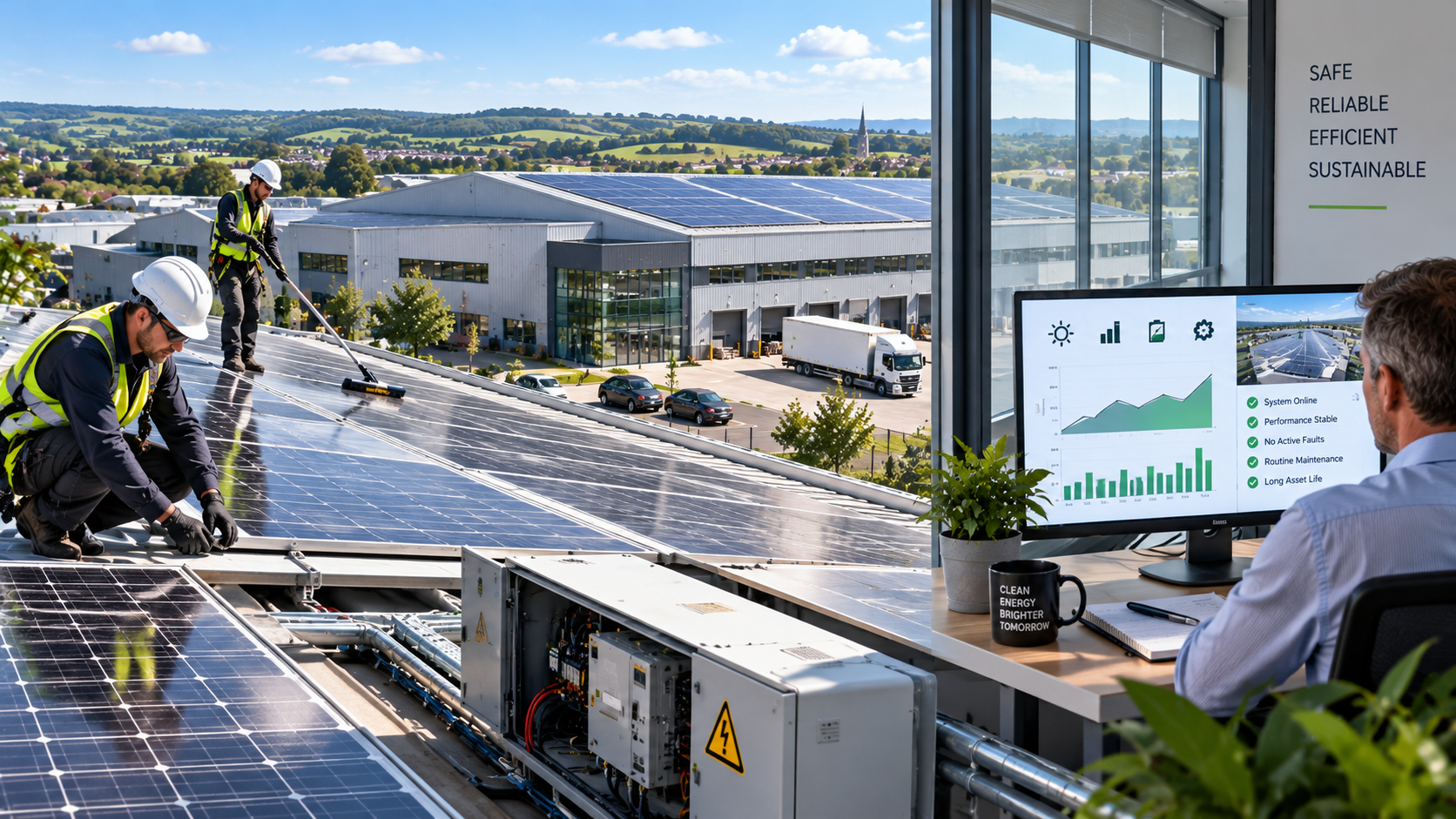
Installing commercial solar on a factory roof is not the end of the project. It is the beginning of managing a long-term energy asset.
A large industrial PV system can contain hundreds or thousands of modules, multiple inverters, extensive DC and AC cabling, mounting equipment, isolators, monitoring hardware and interfaces with the factory’s electrical infrastructure. Protecting the original business case therefore requires an appropriate operations and maintenance strategy.
For UK manufacturers, commercial solar maintenance is about more than keeping panels clean. It combines performance monitoring, safe inspections, preventative maintenance and timely fault response so that problems are identified before avoidable lost generation becomes expensive.
Why commercial solar maintenance matters to factories
If part of a solar installation underperforms, the factory may simply begin importing more electricity from the grid. Unless someone is monitoring system performance, that lost generation may not be immediately obvious from the electricity bill alone.
That makes maintenance a financial issue as well as an engineering and safety issue. The objective is to keep the system operating safely and as close as practical to expected performance throughout its working life.
1. Monitor solar generation continuously
Modern commercial PV systems should provide performance data that allows owners or their O&M provider to identify abnormal behaviour. Monitoring can help reveal inverter outages, communications failures, unexpectedly low generation and other performance anomalies.
Manufacturers should establish who is responsible for reviewing alerts and, importantly, what happens after an alert is received. Data only protects the investment when there is a defined response process.
This also complements our guide to maximising factory solar self-consumption, because reliable generation data helps businesses understand how much solar electricity is actually being used on site.
2. Inspect the electrical system professionally
Commercial and industrial solar installations involve high-voltage electrical equipment and should be inspected and maintained by appropriately competent professionals. The maintenance plan may cover inverters, isolators, protection devices, cabling, connectors, distribution equipment and monitoring systems, alongside the PV array itself.
Factories should retain appropriate documentation and maintenance records so that faults, repairs and recurring issues can be tracked over time.
3. Don’t assume every solar array needs frequent cleaning
Panel cleaning should be based on site conditions and evidence rather than an arbitrary calendar. Rainfall can remove some ordinary surface dirt, while industrial dust, bird fouling, nearby processes, vegetation and other local conditions can create different requirements from one factory to another.
The sensible approach is to assess whether soiling is materially affecting output and then use appropriate professional cleaning methods where required. Unnecessary rooftop work introduces cost and safety exposure without automatically improving performance.
4. Pay particular attention to inverters
The inverter is central to converting the electricity produced by solar modules into usable AC electricity. Monitoring inverter status, fault codes, ventilation and operating conditions should therefore form part of the maintenance strategy.
Where a system has several inverters, comparative performance can also help identify when one section of the array is behaving differently from the others.
5. Inspect mounting systems and roof interfaces
A factory solar installation is also a rooftop asset. Maintenance should therefore consider mounting components, cable management, visible damage, drainage routes and any relevant roof interfaces.
Roof work should always be planned around safe access and the site’s own health and safety procedures. Solar maintenance should never encourage untrained staff to access the roof or electrical equipment.
6. Compare actual generation with expected performance
A useful maintenance programme asks a simple question: is the system producing what it reasonably should under the prevailing conditions?
Comparing monitored output with expected performance can help identify deterioration or faults that are not obvious from a visual inspection. It also gives finance and sustainability teams better-quality information when assessing the ongoing return from the installation.
Correct design at the beginning remains important. Our guide to correctly sizing a commercial solar installation explains why system size should be matched to the site’s electricity profile and commercial objectives.
7. Coordinate maintenance with factory operations
Manufacturing sites have operational constraints that ordinary commercial buildings may not. Maintenance may need to consider production schedules, delivery movements, roof-access restrictions, electrical shutdown procedures and critical processes.
Planning O&M around these constraints can reduce disruption while ensuring that maintenance is not repeatedly postponed because production takes priority.
A practical commercial solar maintenance checklist
- Confirm who monitors system performance and alarms.
- Keep contact and escalation procedures current.
- Arrange competent electrical and mechanical inspections at appropriate intervals.
- Review inverter status and recurring fault codes.
- Assess panel condition and cleaning requirements based on evidence.
- Inspect relevant mounting, cable-management and roof-interface conditions.
- Record faults, maintenance activity and corrective work.
- Compare actual generation with expected performance.
- Coordinate rooftop and electrical work with factory safety procedures.
- Review the O&M strategy when the factory’s operations or electricity demand change.
Industry guidance for rooftop solar O&M
Solar Energy UK published updated Rooftop O&M Guidelines in December 2025. The industry guidance covers areas including safe maintenance, monitoring, cleaning, inspections and fault identification for rooftop PV systems.
Manufacturers can review the Solar Energy UK Rooftop O&M Guidelines alongside the requirements and recommendations specific to their own installation.
Commercial solar should be managed as a long-term asset
The strongest commercial solar projects do not stop at installation. They combine appropriate design, monitoring, maintenance and energy management throughout the system’s operating life.
For factories, that means treating the roof as part of the site’s energy infrastructure: measure performance, investigate faults promptly, maintain equipment safely and keep the system aligned with the factory’s changing electricity needs.
Frequently asked questions
How often should commercial solar panels be maintained?
There is no single maintenance interval suitable for every factory. System size, equipment, manufacturer recommendations, site conditions, roof environment and operating history should inform the maintenance plan.
Do factory solar panels need cleaning every year?
Not necessarily. Cleaning requirements depend on local soiling and whether it is materially affecting performance. An evidence-led approach avoids unnecessary rooftop work.
Can solar monitoring detect faults?
Monitoring can identify abnormal generation, inverter outages, communications problems and other performance issues, but it does not replace appropriate physical inspection and maintenance.
Can factory staff maintain commercial solar themselves?
Electrical and rooftop work involves significant hazards. Inspection and maintenance requiring access to electrical or rooftop equipment should be undertaken by appropriately competent professionals under suitable safety procedures.
Does maintenance affect solar ROI?
Maintenance and monitoring can protect the investment case by helping identify avoidable lost generation and equipment problems. The financial impact will depend on the nature and duration of any fault and the site’s electricity economics.
Protect the performance of your factory solar investment
Commercial Solar Systems specialises in solar solutions for UK factories and industrial businesses. If you are planning a new installation, start by understanding the system design, monitoring and long-term operating requirements rather than considering installation day as the finish line.
Explore our solar panels for factories guide or call 0333 888 0607 to discuss your site.